[E0019]
Palladium-Catalyzed
Coupling of Silyl-Acetylenes to Aryl Halides Using Microwave Irradiation
Ulrik
S. Sørensen,
Judith Wede, and Esteban Pombo-Villar*
Nervous
System Research, Novartis Pharma AG, Basel, Switzerland
Received: 15 August 2001 / Uploaded 22 August 2001
It
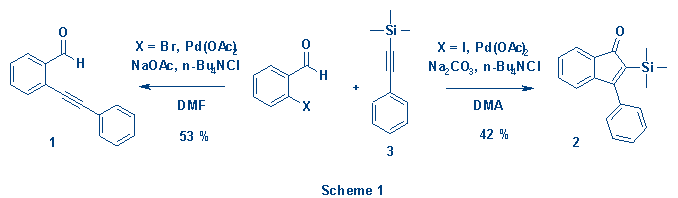
has previously been reported that the reaction between 2-iodobenzaldehyde
and 1-phenyl-2-(trimethylsilyl)acetylene (3) in the presence of
palladium acetate gives the corresponding 2-trimethylsilyl-substituted
indenone 2.1 When repeating this experiment, using slightly
different reaction conditions and replacing 2-iodobenzaldehyde with 2-bromobenzaldehyde,
we did, however, not isolate the above mentioned indenone but rather the
cross-coupling product 1 (Scheme 1).
This
finding prompted us to study this Sonogashira-type coupling of 1-phenyl-2-(trimethylsilyl)acetylenes
to give disubstituted acetylenes. The Sonogashira coupling is well-known
as the synthesis of substituted acetylenes by coupling aryl or vinyl halides
with terminal acetylenes in the presence of a palladium catalyst and CuI
as cocatalyst.2 Numerous reports describe the coupling of trimethylsilylacetylene
with aryl halides in Sonogashira type reactions, and the trimethylsilyl
(TMS) group is generally unaffected and thus functions as a protecting
group which can be subsequently removed to furnish a new terminal alkyne.3
However,
in the reaction shown above the coupling product 1 is achieved without
previous deprotection of the TMS group of 3. A recent study on the
Pd-Cu cocatalyzed cross-coupling of (arylethynyl)trimethylsilanes and aryl
halides or triflates concluded that copper was required for this reaction
to occur.4 However, the result of our work is a procedure for
the coupling of 1-phenyl-2-(trimethysilyl)acetylenes with arylhalides to
give 1-aryl-2-phenyl acetylenes without the use of a copper cocatalyst
and furthermore with short reaction times by the use of microwave5
(MW) irradiation.

The
mechanism for this transformation is not clear, but one could speculate
that the reaction proceeds via a transmetallation pathway (Scheme 2). A
similar mechanism has recently been argued by Itami et al. to explain the
palladium-catalyzed coupling of alkenyl-silanes with aryl- and vinylhalides
in the presence of tetrabutylammonium fluoride.6 Fluoride-induced
silicon to Pd transmetallation has also been invoked in Pd-catalyzed cross
coupling reactions by Hiyama et al.7
When
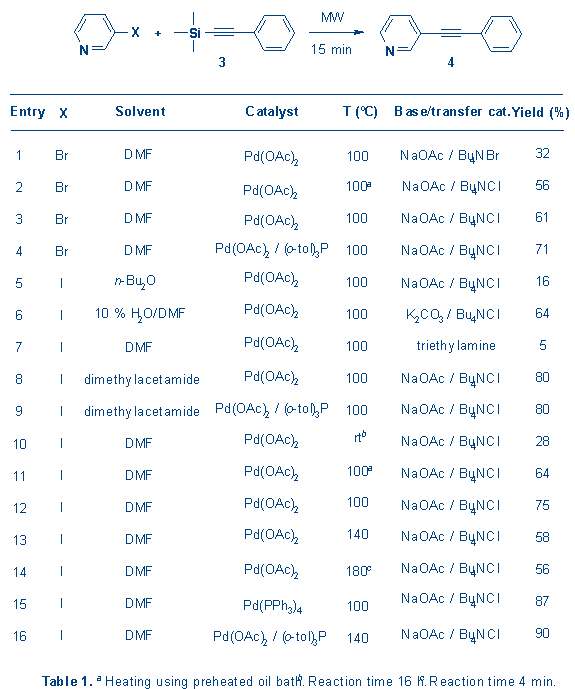
the cross-coupling reaction of 3 and 3-iodopyridine was carried
out at room temperature overnight compound 4 was isolated in a moderate
28 % yield (Table 1, entry 10). To reduce the reaction time and improve
the yield we increased the reaction temperature by means of MW irradiation.
The results of these experiments, aimed at identifying optimized reaction
conditions, are shown in Table 1 and gave compound 4 in up to
90 % isolated yield.
For
most experiments DMF was used as solvent. Being highly polar, it
absorbs microwaves well, resulting in very rapid heating. Using 50 ml of
DMF and irradiation at 450 W we observed a temperature increase from room
temperature to 100 ºC within approximately 30 seconds. This rapid
heating may explain the higher yield obtained using MW as compared to
conventional heating. Thus, in an otherwise identical experiment, 4
was isolated in 64 % yield (Table 1, entry 11) when heating on an oil bath
as compared to 75 % (Table 1, entry 12) when applying MW. A similar difference,
although less marked, was found when starting from 3-bromopyridine (Table
1, entry 2 and 3).
Among
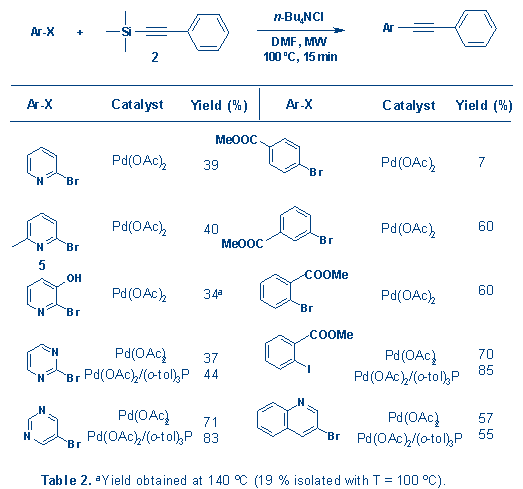
the synthesized compounds is the neuroactive compound 2-methyl-6-(phenylethynyl)-pyridine
(MPEP, synthesized from 5), a highly potent and selective metabotropic
glutamate receptor antagonist.8
As
can be seen from both Tables 1 and 2, the addition of tri(o-tolyl)phosphine
in most cases resulted in significantly improved yields. This could be
caused by a stabilizing effect of this ligand on the reactive palladium
species, as previously discussed for e.g. the palladium-catalyzed Heck
coupling.9
To
broaden the scope of the reaction we are also interested in introducing
functionalized substituents. Thus, in a preliminary experiment, using as
substrate trimethylacetylene 6, it was possible to introduce the
benzaldehyde moiety and obtain the desired coupling product 7 in
60 % yield (Scheme 3).

In
summary,
we have developed a method for direct coupling of 1-phenyl-2-(trimethylsilyl)-acetylenes
with aryl- and heteroarylhalides, to give disubstituted acetylenes without
initial TMS deprotection and without the use of a copper cocatalyst.
Example
of experimental procedure. Synthesis of 3-(phenylethynyl)pyridine (4).
3-Iodopyridine (2.50 mmol), 3 (5.00 mmol), Pd(OAc)2 (0.125
mmol), n-Bu4NCl (2.50 mmol), tri(o-tolyl)phosphine
(0.25 mmol), and NaOAc (10.0 mmol) in dry DMF (50 ml) were heated under
Ar in the MW oven10 for 15 minutes at 100 °C. After cooling,
the reaction mixture was added saturated NaHCO3. Usual work
up and silica gel CC (0-10 % EtOAc in hexane) gave 4 as a dark solid
(90 %) which was fully characterized by 1H-NMR, 13C-NMR,
mp, MS (ES+), and HRMS.
*
Address correspondence to: [email protected] 1) Larock,
R. C.; Doty, M. J.; Cacchi, S. J. Org. Chem. 1993, 58,
4579. 2) a. Sonogashira, K.; Tohda, Y.; Hagihara, N. Tetrahedron Lett.
1975, 4467. b. (review) Rossi, R.; Carpita, A.; Bellina, F. Org.
Prep. Proc. Int.1995, 27, 127. 3) Takahashi, S.; Kuroyama,
Y.; Sonogashira, K.; Hagihara, N. Synthesis 1980, 627. 4)
Nishihara, Y.; Ikegashira, K.; Hirabayashi, K.; Ando, J.-i.; Mori, A.;
Hiyama, T. J. Org. Chem. 2000,
65, 1780. 5) (recent
reviews) a. Caddick, S. Tetrahedron 1995,
51, 10403.
b. Strauss, C. R.; Trainor, R. W. Aust. J. Chem. 1995,
48,
1665. c. Galema, S. A. Chem. Soc. Rev.
1997, 26, 233. 6) Itami, K.; Nokami, T.; Yoshida, J.-i. J.
Am. Chem.
Soc.
2001, 123, 5600. 7) Hiyama, T.; Hatanaka, Y. Pure Appl.
Chem. 1994, 66, 1471, and references cited therein. 8)
a. Gasparini, F.; Lingenhöhl, K.; Stoehr, N.; Flor, P. J.; Heinrich,
M.; Vranesic, I.; Biollaz, M.; Allgeier, H.; Heckendorn, R.; Urwyler, S.;
Varney, M. A.; Johnson, E. C.; Hess, S. D.; Rao, S. P.; Sacaan, A. I.;
Santori, E. M.; Veliçelebi, G.; Kuhn, R. Neuropharmacology1999,
38, 1493. b. Salt, T. E.; Binns, K. E.; Turner, J. P.; Gasparini,
F.; Kuhn, R. Br. J. Pharmacol. 1999, 127, 1057. 9)
Beletskaya, I. P.; Cheprakov, A. V. Chem. Rev. 2000, 100,
3009. 10) All MW experiments were carried out in a MLS-Ethos 1600 instrument
from Milestone except for entry 14 Table 1 which was performed using the
PersonalChemistry SmithCreator™.