Saeed Balalaie* and Elahe Kowsari
Department of Chemistry, K. N. Toosi University of Technology, P. O. Box 15875-4416 Tehran-Iran, Fax: +98-21-2853650 E-mail: [email protected]
Received: 15 August 2001 / Uploaded 22 August 2001
Keywords. Cyclocondensation; Microwave Irradiation; Solvent-free condition; 1,4-Dihydropyridines.
Introduction
4-Aryl-1,4-dihydropyridines of the nifedipine type are of interest because of their Ca2+ antagonistic and agonistic activities [1]. N-Substituted 1,4-dihydropyridines without substituents in positions 2 and 6 exhibit many pharmaceutical activities and are highly light - sensitive in the solid state. It has been shown that these compounds could be dimerized; the dimers are of interest as novel potential inhibitors of HIV-1 protease and have anticancer activity [2].
There are many methods for the synthesis of N-substituted 1,4-dihydropyridines
[3]. For the preparation of 2,6-unsubstituted 1,4-dihydropyridines, propiolates
are used instead of
b-dicarbonyl compounds. Cyclocondensation
of aldehydes, propiolates, and ammonium acetate in refluxing AcOH followed
by N-alkylation and cyclocondensation of propiolates, aromatic aldehydes
and primary amines under reflux resulted in N-substituted 1,4-dihydropyridines
[4,5]. N-Methyl derivatives were produced by methylation of 1,4-dihydropyridine
anions in dimethyl propylene urea (DMPU). Meanwhile it has been found that
photochemical addition of alkenes to enaminocarbaldehydes lead to tetrahydropyridines
that undergo dehydration to give N-substituted 1,4-dihydropyridines [6,7,8].
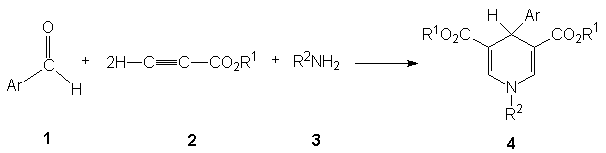
A combinations of supported reagents and microwave irradiation has been used to carry out a wide range of reactions under solvent-free conditions [9]. In connection with our previous work on solid state organic synthesis under microwave irradiation [10] we report the three-component condensation of benzaldehyde derivatives, alkyl propiolates, and primary amines on the surface of silica gel, montmorillonite K-10, acidic alumina, and zeolite HY with acidic character under microwave irradiation, as a useful method for the synthesis of N-substituted 4-aryl-1,4-dihydropyridines.
Results and Discussion
In order to select the best solid support for this reaction we investigated the condensation of benzaldehyde, ethyl propiolate and benzylamine on silica gel, montmorillonite K-10, acidic alumina, and zeolite HY under microwave irradiation. Under all conditions reaction product was 4e (62, 44, 41, and 31%). The best yields were obtained with silica gel as the solid support (Table 1). With zeolite HY, yields were lower, because the acidic Brønsted sites were partly occupied by the electron pairs of amine nitrogen atoms. It seems that the reaction proceeds on the surface of zeolite HY because the size of channels in zeolite HY is only around 7 Å.
Scheme 1
The products were characterized by their IR and 1H-NMR spectroscopic data and melting points. In the 1H-NMR spectra, the peak at 4.80-5.00 ppm is related to 4-H and is indicative of the reaction products. In the IR spectra, the absence of the carbonyl group and acetylene bands are in accordance with the structure of the reaction products. Microwave irradiation in the absence of solid support under neat conditions resulted in low yields, and the reactants and products adhered to the reaction vessel and led to irreproducible results. The cyclocondensation was also carried out in HOAc without solid support under microwave irradiation, but yield and reproducibility were low and work-up was difficult. In all experiments, the optimized time of irradiation was 4 minutes.
Table 1. Solvent-free synthesis of N-substituted 4-aryl
-1,4-dihydropyridines 4a –4h under microwave irradiation.
|
|
|
|
|
|
|
|
||||
|
|
|
|
|
|
|
|
|
|
|
|
|
|
|
|
|
|
|
|
|
|
|
|
|
|
|
|
|
|
|
|
|
|
|
|
|
|
|
|
|
|
|
|
|
|
|
|
* In all experiments, optimized time of irradiation was 4
minutes. Silica gel was used as the solid support.
We also tried to synthesize the pyrimidine skeleton via a three-component condensation of N,N´-dimethyl urea, methyl propiolate, and benzaldehyde on silica gel under microwave irradiation, but we obtained dimethyl-1-methyl-1,4-dihydro-4-phenylpyridine-3,5-dicarboxylate. Under these conditions, dimethyl urea decomposed to methylamine and methyl isocyanate and the resulting methylamine condensed with methyl prioplate and benzaldehyde to give the above dihydropyridine [11].
In conclusion, N-substitued 4-aryl-1,4-dihydropyridines are versatile intermediates in the synthesis of pharmacologically active products. Current methods of preparation lead to relatively large amounts of waste; our method is clean and environmentally friendly. The advantages of the method are a) reduction of reaction steps, b) absence of solvents c) employment of reusable solid catalysts d) high yields e) short reaction times and f) easy reaction set-up and work-up.
Experimental
Melting points were measured on an Electrothermal 9100 melting point apparatus and are uncorrected. IR spectra were recorded on a Shimadzu IR-408 spectrometer in KBr disks. 1H NMR spectra were determined in CDCl3 with TMS as internal reference on a Bruker 80 MHz FT-NMR spectrometer. Elemental analysis was performed using a CHN-O Heraeus instrument; the results agreed favorably with the calculated values. Mass spectra were recorded on a GC-MS QP 1100 Shimadzu instrument (70 eV). A domestic microwave oven (Moulinex 2735A) at 2450 MHz (100% power corresponding to 850 W) was used in all experiments.
General procedure
The benzaldehyde derivative (4 mmol), alkyl propiolate (8 mmol), primary amine (4 mmol), and 2 g silica gel were mixed thoroughly in a mortar. Then the reaction mixture was transferred to a beaker and irradiated with microwaves for 4 minutes. The progress of reaction was monitored by TLC. The mixture was extracted with 3´ 30 cm3 CH2Cl2, filtered, and dried with anh. Na2SO4 sulfate. The solvent was removed by a rotary evaporator under reduced pressure. Further purification by recrystallization gave the desired pure products 4a-h.
Dimethyl-1-benzyl-1,4-dihydro-4-(4-methoxyphenyl)-pyridine-3,5-dicarboxylate (4a)
Yield = 90% (petroleum ether: diethyl ether 2:1); m.p. : 120-121° C ([2d]: 120-122° C); IR (KBr): n = 1705, 1604 cm-1; 1H NMR (CDCl3, d, 80 MHz): 3.55 (s, 3H, OCH3), 3.70 (s, 3H, OCH3), 4.50 (s, 2H, NCH2), 4.80 (s, 1H, 4-H), 6.60-7.35 (m, 11H, aromatic H, 2,6-H) ppm.
Diethyl-1-benzyl-1,4-dihydro-4-(4-methoxyphenyl)- pyridine-3,5-dicarboxylate (4b; C25H27NO5)
Yield: 76% (n-Hexane: diethyl ether 2:1); m.p. : 104-106° C ([2d]: 104-106° C); IR (KBr): n = 1705, 1664, 1605 cm-1; 1H-NMR (CDCl3 , d , 80 MHz): 1.16 (t, J = 7 Hz, 6H, CH2CH3), 3.75 (s, 3H, 4CH3O-C6H4) 4.06 (q, J = 7 Hz, 4H, CH2CH3), 4.57 (s, 2H, NCH2), 4.85 (s, 1H, 4-H), 6.70-7.35 (m, 11H, aromatic H, 2,6-H), 13C-NMR (CDCl3 , d , 20 MHz): 37.10, 55.20, 58.15, 60.20, 109.10, 113.30, 127.20, 128.10, 129.30, 136.10, 137.25, 158.40, 167.20 ppm.
Dimethyl 1-methyl-1,4-diydro-4-(4-methoxyphenyl)- pyridine-3,5-dicarboxylate (4c)
Yield: 90% (Petroleum ether: diethyl ether 2:1); m.p. : 200-202° C ([2d] 200-202° C), IR (KBr) n = 1705, 1608 cm-1; 1H NMR (CDCl3, d, 80 MHz): 3.20 (s, 3H, -NCH3), 3.60 (s, 6H, CO2CH3), 3.70 (s, 3H, 4-CH3O-C6H4), 4.82 (s, 1H, 4-H), 6.70-7.25 (m, 6H, aromatic H, 2-, 6-H) ppm.
Dimethyl-1-Benzyl-4-dihydro-4-phenyl pyridine-3,5-dicarboxylate (4d; C22H21NO4)
Yield: 90 % (Petroleum ether: diethyl ether 2:1); m.p. : 160-162 ° C, IR (KBr): n = 1695, 1660, 1580 cm-1; 1H NMR (CDCl3, d, 80 MHz): 3.40 (s, 6H, CO2CH3), 4.40 (s, 2H, NCH2) 4.80 (s, 1H, 4-H), 6.90-7.40 (m, 12H, aromatic H, 2,6-H) 13C NMR (CDCl3, d, 20 MHz): 37.00, 51.00, 59.00, 109.10, 125.10, 126.20, 127.50, 129.30, 136.10, 136.50, 138.20, 147.10, 168.20 ppm. Elemental analysis; Calculated (%) C 72.72, H 5.78, N 3.85, O 17.63; Found, (%) C 72.12, H 5.77, N 3.82, O 18.29;
Diethyl –1- benzyl-1,4-dihydro-4-phynylpyridine-3,5-dicarboxylate (4e; C24H25NO4)
Yield: 62 % (Petroleum ether: diethyl ether 2:1); m.p. : 133-135°
C, IR (KBr) n = 1695, 1580 cm-1;
1H NMR (CDCl3 , d , 80
MHz) 1.10 (t, 6H, J = 7.1 Hz, 2CH3), 3.95 (q, 4H,
J = 7.1 Hz, 2CH2) 4.45 (s, 2H –NCH2) 4.80 (s,
1H, 4-H), 6.90-7.70 (m, 12H, aromatic H, 2,6-H) ppm.; [M] .+
= 391, 362 [M-C2H5] .+ , 346 [M-OC2H5]
+ , 314 [M-Ph] .+ , 91 [benzyl]+.
Dimethyl-1-benzyl-1,4-dihydro-4-(4-bromophenyl)-pyridine-3,5-dicarboxylate (4f; C22H20BrNO4)
Yield: 94 % (Petroleum ether: diethyl ether 2:1); m.p. : 186-189 ° C; IR (KBr): n = 1710, 1590 cm-1; 1H NMR (CDCl3, d, 80 MHz) 3.50 (s, 6H, -CO2CH3), 4.40 (s, 2H, -NCH2), 4.80 (s, 1H, 4-H), 6.90-7.60 (m, 11H, aromatic H, 2,6-H) ppm; [M] .+ = 441, [M+2] .+ = 443, 410 [M-OCH3] .+, 286 [M-C6H4Br] .+, 91 [benzyl]+, 59 [CO2CH3] .+.
Diethyl-1-butyl-1,4-dihydro-4-(4-methoxyphenyl)-pyridine-3,5-dicarboxylate (4g; C22H29NO5)
Yield: 90 % (Petroleum ether: diethyl ether 2:1); m.p. : 117-119° C; IR (KBr): n = 1705, 1605, 1980cm-1; 1H NMR (CDCl3 , d , 80 MHz), 1.10 (t, 3H, J = 7.1 Hz, CH3), 1.20 (t, 6H, J = 7.1Hz, 2CH3), 1.40-1.80 (m, 4H, 2CH2), 3.50 (t, 2H J=7.1 Hz, -NCH2), 3.5, (s, 3H, -OCH3), 4.15 (q, 4H , J=7.1 Hz, 2-OCH2), 4.90 (s, 1H, 4-H), 6.8-7.30 (m, 6H aromatic H, 2-,6-H) ppm; Elemental analysis: Calculated (%) C 68.22, H 7.49, N 3.62, O 20.67 Found: (%) C 67.90, H 7.44, N 3.67, O 20.99
Diethyl-1-cyclohexyl-1,4-dihydro-4-(4-methoxyphenyl)-pyridine-3,5-dicarboxylate (4h; C24H31NO3)
Yield: 68 % (n-Hexane: diethyl ether 2:1); m.p. : 137.6-138.5°
C; IR (KBr);
n = 1700, 1600 cm-1; 1H
NMR (CDCl3 , d , 80 MHz) ; 1.0 (t,
6H, J = 7.1 Hz, 2CH2CH3), 1.20-1.90 (m, 10H, 5CH2)
3.10 (m, 1H, N-CH), 3.60 (s, 3H, OCH3), 3.90 (q, 4H, J = 7.1,
2-OCH2CH3) 4.70 (s, 1H, 4-H), 6.60-7.15 (m, 6H aromatic,
2-,6-H) ppm; [M] .+ = 413 , 384 [M-C2H5]
.+ , 368 [M-OC2H5].+,
340 [M-CO2C2H5] .+,
306 [M-C7H7O] .+.
References:
b) Staut D M, Meyers A I (1982) Chem Rev 82: 223
b) Hilgeroth A, Wiese M, Billich A (1999) J Med Chem 42:
4729
c) Hilgeroth A, Baumeister U, Heinemann F W (1999) Heterocycles 51: 2367
d) Hilgeroth A, Heinemann F W (1998) J Heterocyclic Chem 35: 359
e) Hilgeroth A Baumeister U, Heinemann F W (1998) Eur J Org Chem 1213
b) Strauss C R, Trainer R W (1995) Aust J Chem 48: 1665
c) Loupy A, Petit A, Hemelin J, Texier-Boullet, F Jacquautt P and Mathe D (1998) Synthesis 1213
d) Varma R S (1999) Green Chem 1: 43
e) Varma R S (1999) Clean Procucts and Processes 1: 132
b) Balalaie S, Arabanian A, Hashtroudi M S (2000) Monatsh Chem 131:
945
c) Balalaie, S, Arabanian A (2000) Green Chem 2: 274
d) Balalaie S, Sharifi A, Ahangarian B (2000) Indian J Heterocyclic Chem 10: 149
e) Balalaie S, Golizeh M, Hashtroudi M S (2000) Green Chem 2: 277
f) Balalaie S, Nemati N (2001) Heterocyclic commun. 7: 67