 (1)
Microwave Assisted Chlorobenzene Hydrochlorination
I.Calinescua, M.Radoiub, R.Calinescua, D.Martinb
a Polytechnic University of Bucharest, Industrial Chemistry Faculty,
Calea Victoriei 149, R-71102 Bucharest, Romania, e-mail: [email protected]
b National Institute for Lasers, Plasma and Radiation Physics, Electron
Accelerator Laboratory, P.O. Box MG-36 Magurele, R-76900 Bucharest, Romania
, e-mail:[email protected]
Received: 20 August 2001 / Uploaded 21 August 2001
Introduction
In recent years the disposal of chlorinated organic wastes has become a major environmental concern. Typically these wastes have been landfilled or incinerated. Some years ago the placement of chlorinated hydrocarbons in landfill was prohibited, due to their low biodegradability [1]. Incineration however, can result in the formation of highly toxic byproducts such as dioxins. As a result, there has been considerable interest in finding alternate methods for destruction of chlorinated aromatic wastes.
Catalytic hydrodehalogenation with homogeneous or heterogeneous catalyst is recognized as a facile and efficient procedure. Sometime hydrogen in gas phase [2-3] is used or other time alcohol as hydrogen donor [4-7] is used.
The practical application of catalyst to the dehalogenation of organic halides is always accompanied by the problem of the deactivation of catalyst. In heterogeneous catalyst system the activity change may be caused by adsorption of halogen, halogenation of catalyst, surface composition change of catalyst and formation of oligomers and coke [8]. For practical use, the development of a reaction procedure where the catalytic activity is maintained for a prolonged time is an essential problem.
The catalytic dehalogenation reaction was carried out under microwave irradiation, at atmospheric pressure and reflux temperature of the reaction mixture formed by 2-propanol, chlorobenzene, NaOH and catalyst. The proposed reaction scheme is as follows:
(1)
 (2)
 (3)

where H* indicates the hydrogen-transfer species.
A characteristic of this catalytic system is that the substitution of halogen by hydrogen occurs selectively without hydrogenation of the aromatic ring. Therefore, benzene hydrogenation was not observed and benzene was the final product.
Water and HCl were formed. NaOH was used in order to remove the HCl formed during the hydrodehalogenation reaction. An appropriate amount of NaOH was to be reached in order to keep the catalyst activity.
The aim of this study was to find the optimum receipt, taking into consideration all the reaction conditions (catalyst type and amount, NaOH amount, experimental procedure – classical, microwave and electron accelerating), more experiments were performed. In each experiment one condition was changed.
A commercial domestic microwave oven properly modified was used as microwave applicator. Modifying the oven magnetron power supply produced the variable power up to 850 W.
For both the classical and microwave heating procedures, all the experiments were performed in a 100-ml Pyrex vessel fitted with water-cooled condenser.
A solution (25 ml) of 2-propanol containing chlorobenzene (1 wt.% - 100 mmol*l-1) and NaOH was placed in the reactor. After that an appropriate amount of catalyst was added. The reaction took place at reflux temperature (80 °C).
The process was analyzed by GC method. Samples were taken at 15 min, 30 min and 60 min, diluted with a solvent (CH2Cl2) and filtered in order to remove traces of the catalyst. From the GC analysis data (concentrations of benzene and chlorobenzene) the molar concentrations and chlorobenzene conversion were determined.
a) The Catalyst Type
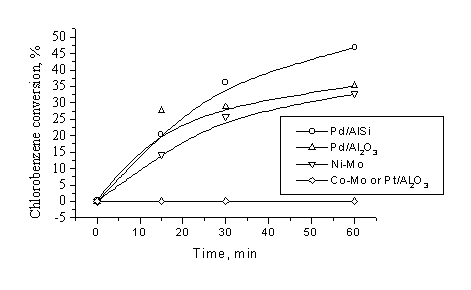
Few catalysts were used: Pd, Pt, Ni-Mo, Co-Mo, using different supports (Al2O3 and aluminium silicate - AlSi); in order to find out the best option of catalyst and the most appropriate amount. All the catalysts that were used were firstly milled and dried in the oven. Afterwards, they were kept in a dessicator. All of them were of high – purity grade and, therefore, no further purification was needed.
The first case was that of the traditional heating, using the same amount of NaOH (0.3 g) and the same amount of catalyst (0.1 g). The solution of chlorobenzene and 2-propanol had the same composition all along the experimental procedure (25-ml solution, 1% concentration). The results showed that the catalysts Co-Mo and Pt/Al2O3 were not active in this case. All the others were active. The results are presented in the figure1. At the same time we noticed that the most efficient active catalyst was that of Pd/AlSi, for this case, after 60 min of heating, the conversion of the reactant was as high as 50%.
b) The Amount of NaOH
The NaOH was used in order to capture the HCl evolved from the reaction. It was found that in the absence of NaOH the reaction does not take place. But a too large amount of NaOH decreases the reaction rate. The best option was found to be for 0.15 g of NaOH. The results are presented in the figure 3.
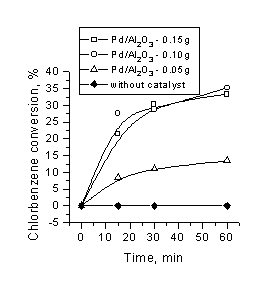
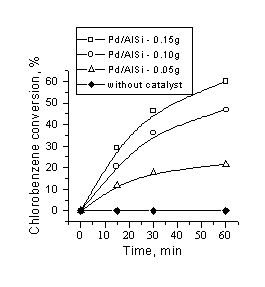
Fig.2 Catalytic dechlorination of chlorobenzene. The influence of catalyst amount. Reaction conditions: 2-propanol (25 ml); chlorobenzene (100 mmol*l-1); NaOH (0.3 g – 300 mmol*l-1); conventional heating.
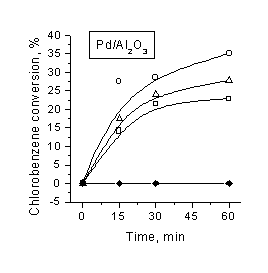
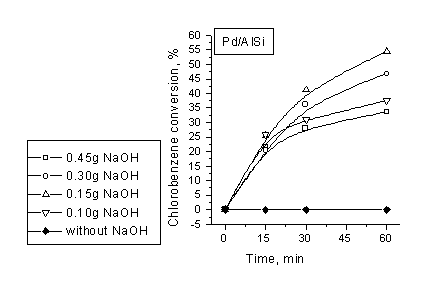
Fig.3 Catalytic dechlorination of chlorobenzene. The influence of NaOH
amount. Reaction conditions: 2-propanol (25 ml); chlorobenzene (100 mmol*l-1);
catalyst (0.1g); conventional heating.
After establishing the most efficient type of catalyst and the most
appropriate amounts of NaOH, the next stage was to make a comparison between
the two types of heating: the traditional heating and the microwave irradiation
(the heating in this case is a secondary effect). For all the tested active
catalysts, for all the amounts of catalysts and NaOH the trend was the
same: in the case of microwave irradiation the conversions of the reagent
were higher than in the case of traditional heating. The results are presented
in figure 4.
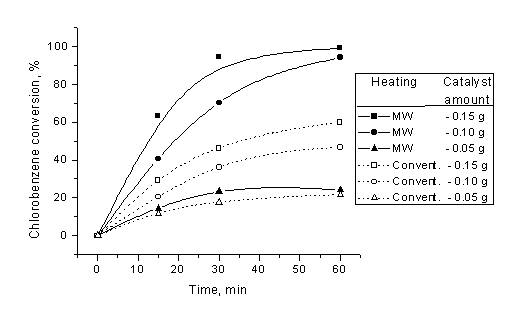
Figure 4. Catalytic dechlorination of chlorobenzene. The influence of heating type. Reaction conditions: 2-propanol (25 ml); chlorobenzene (100 mmol*l-1); NaOH (0.3 g – 300 mmol*l-1).
During the process, a certain degree of catalyst deactivation appears. According to literature data [8], this is due to the presence of acetone or water in the reaction medium, or to NaCl deposits on the catalyst surface. As this study was performed only in diluted solutions of chlorobenzene, the assumption that catalyst deactivation was only to NaCl deposits was made.
As we may notice, the heating type is also important. The microwave heating had a very favorable effect and that could be due to NaCl dislocations. These particles tend to deposit on the catalyst surface. Thus, for microwave heating, the conversions were, in some cases, almost double than in the case of classical heating.
Conclusions
The aim of this study was to examine the chlorobenzene hydrodechlorination in heterogeneous liquid phase. The catalytic dehalogenation reaction was carried out at atmospheric pressure and reflux temperature of the reaction mixture formed by 2-propanol, chlorobenzene, NaOH and catalyst.
The reaction was affected by the catalyst type, catalyst amount, the concentration of NaOH and the heating type.
The best catalyst found was Pd which activity is better than the activities of Ni-Mo, Pt or Co catalysts.
The amount of NaOH is important, too. Even in the presence of catalysts and microwave, the process does not take place in the absence of sodium hydroxide.
The optimum quantity of NaOH was found to be in slight stoichiometric excess as regarding the chlorobenzene concentration (0.3 g NaOH represent a 3:1 molar report as regarding the chlorobenzene).
A gradual decrease in catalytic activity was observed, probably because of the accumulation of NaCl on the catalyst surface.
The microwave heating had a very favorable effect and that could be due to NaCl dislocations. Thus, for microwave heating, the conversions were, in some cases, almost double than in the case of classical heating.