 |
Microwave promoted radical cyclization of trihaloacetamides |
 |
[a0026]
|
Microwave promoted radical cyclization of trihaloacetamides |
|
Julio A. Seijas*, M. Pilar Vázquez-Tato*, Mercedes Jover
Received: 5 August 1999 / Uploaded: 22 August 1999
Pyrrolidines bearing bicyclic skeletons are components of various
alkaloids or amino acid derivatives with important physiological activities. The efficient
construction of the pyrrolidine ring is important in their synthesis. In the last years,
most of the synthetic routes via radical cyclization of heteroatom-containing substrates,
are based in generating an alkyl radical by treatment of haloalkanes with a radical
initiator such as AIBN. One of the disadvantages of this methodology, which requires
working with labile reagents, is the formation of a secondary product arising from the
reduction of the halogen atom, on the contrary the copper (I) catalyzed radical atom
transfer cyclization lack of this problem. We reported previously the synthesis1 of pyrrolizidines by homolysis of trichloroacetamides in
the presence of a catalytic amount of Cu(I). These reactions are usually performed in a
sealed tube and heating acetonitrile at temperatures around 150°C2. Although less harsh conditions are needed when TMEDA3and sometimes bipyridine 4
are used.
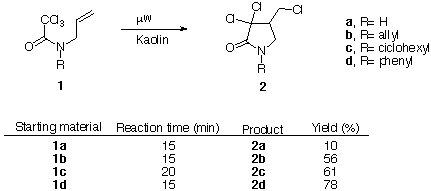 |
Here we describe a new method, carrying out these reactions by irradiating with microwaves. Our first attempt was to irradiate a mixture of CuCl and allyltrichloroacetamides. As we had some sparking on the reaction beaker, we chose to use a solid support with reagents adsorbed on its surface. We tried some supports the better yields were obtained when kaolin was used. The cyclization of N-allyltrichloroacetamide gave poor yield, probably due to its high volatility, but when secondary amides were irradiated we obtained yields ranging between 56-78%.
ACKNOWLEDGMENTS
We thank Dirección General de Enseñanza Superior for its financial support (PB96-0932).
1.-Seijas, J. A., Vázquez-Tato, M. P., Castedo, L., Estévez, R. J., Ónega, M. G, Ruíz M., Tetrahedron, 1992, 48, 1637.
1.- Bellus, D., Pure Appl. Chem. 1985, 43, 1919.
2.- Benedetti, Forti, Ghelfi, F., Pagnoni, U. M., Ronzoni, R., Tetrahedron, 1997, 41, 14031.
3.- Nagashima, H., Ozaki, N. Seki, K., Ishii, M. Itoh, K., J. Org. Chem, 1989, 54, 4497.
All comments on this poster should be sent by e-mail to (mailto:[email protected] ona.edu)
[email protected] with A0026 as the message subject of your e-mail.