[A0036]
Titanocenes Catalyzed Diastereoselective Epoxidation of Allylic Alcohols
Alessandra Lattanzi, Antonio Proto and Arrigo Scettri
Dipartimento di Chimica, Università degli Studi di Salerno, 84081 Baronissi (SA), Italy
E-mail: [email protected]
Received: 10 August 1999 / Uploaded: 26 August 1999
Abstract
Allylic alcohols undergo an efficient process of diastereoselective epoxidation by t-butyl hydroperoxide (TBHP) in n-hexane solution in the presence of catalytic amounts of mono- and dicyclopentadienyl titanium chlorides.
Introduction
One of the typical procedures for the stereoselective synthesis of a,b-epoxyalcohols, well-known building blocks in preparative organic chemistry, is based on the employment of transition metal complexes or compounds as catalysts, for example Ti(OR)4, VO(acac)2, Mo(CO)6, etc., and an oxygen donor, usually t-butyl hydroperoxide (TBHP). As regards titanium alkoxides, the ability to rapidly exchange ligands enables these species to catalyze epoxidation reactions [1].
Rather interestingly, Adam has recently shown that diastereoselective epoxidation of allylic alcohols can be conveniently performed under heterogeneous conditions by using synthetic zeolites incorporating titanium atoms in their lattice [2,3]: good results have been obtained with titanium silicalite 1 (TS-1) and Ti-b zeolite (Ti-beta) in combination respectively with urea-hydrogen peroxide adduct or hydrogen peroxide.
Now we have found that easily available or accessible titanocene chlorides [4,5,6], in spite of their much lower tendency to suffer ligands exchange in comparison with titanium alkoxides, prove to be valuable catalysts in the epoxidation of allylic alcohols (Scheme 1).
Results and Discussion
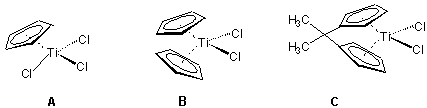
As reported in Table 1 for the representative starting material 1a, the formation of the corresponding product 2a takes place in very good yield and diastereoselectivity with all the tested catalysts A, B, C.
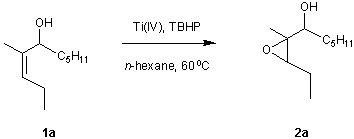
Scheme 1
Table 1. Titanocenes catalyzed epoxidation of allylic alcohol 1a
entry |
catalyst |
reac. time/h |
yield (%)a |
erythro/threob d.r. |
a |
Ti (Oi-Pr)4 |
4 |
47 |
76/24 |
b |
TiCl4 |
17 |
26 |
86/14 |
c |
A |
5 |
91 |
88/12 |
d |
B |
1 |
97 |
84/16 |
e |
C |
1 |
97 |
83/17 |
a
All the yields refer to isolated pure compound 2a, whose structure was confirmed by 1H-NMR data. In all entries 1a/TBHP/catalyst 1/1/0.02 molar ratio was used. Solvent: n-hexane (similar results have been obtained in light petroleum). bErythro/threo diastereoisomeric ratio was determined by 1H-NMR analysis (400 MHz) on the crude 2a.It is noteworthy that epoxidation can be carried out in more safe hydrocarbon solvents (n-hexane or light petroleum) in substitution of the generally used halogenated solvents. The experiment reported in entry b points out that the introduction of one or two cyclopentadienyl ligands exerts a beneficial effect on the activity of the catalyst (entries c and d), while, under the same conditions, Ti(Oi-Pr)4 affords less satisfactory results both in terms of efficiency and diastereoselectivity (entry a).
A set of experiments [7] performed on different primary and secondary allylic alcohols (Scheme 2, Table 2) has confirmed the catalytic properties of titanocenes A, B and C. It has to point out that good yields can be obtained in the presence of really reduced amounts of catalyst (0.1% mol) although a slightly lower diastereoselectivity is usually observed (entry c).
As regards less reactive alcohols, as trans-2-hexen-1-ol, entry e, the poor yields obtained under the usual conditions, can be noticeably improved perfoming the reaction under micro-wave irradiation.
In conclusion, this procedure can be considered of synthetic value for its efficiency and selectivity and, most of all, for the easy work-up: no quenching is required and the heterogeneous active catalytic species can be easily removed by filtration under reduce pressure.
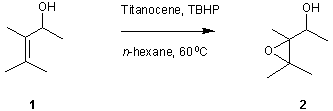
Scheme 2
Table 2. Titanocene catalyzed epoxidation of allylic alcohols 1
entry |
1 |
catalyst |
reac. time/h |
yield (%)a |
a |
|
A B C |
28 4 30 |
75 82 82 |
b |
|
A B C |
21 3 7.5 |
98 (6/96) 98 (8/92) 93 (8/92) |
c |
|
A B C B C |
1.25 3 3 6 22.5 |
98 (83/17) 96 (82/18) 92 (79/21) 66 (76/24)b 89 (78/22)b |
d |
|
A B C |
23 26 28 |
49 (42/58) 83 (43/57) 93 (44/56) |
e |
|
B C B |
6.5 27.5 2 |
40 33 68c |
a
All the yield refer to isolated pure compounds, whose structures were confirmed by 1H-NMR data. In all entries 1/TBHP/catalyst 1/1/0.02 molar ratio was used. Values in parentheses refer to erythro/threo diastereoisomeric ratio determined by 1H-NMR analysis (400 MHz) on the crude 2. bIn these entries 0.001 eq of catalyst were used. cConventional heating was substituted with micro-wave irradiation (P=500 Watts) for eight·15 min. periods.
Acknowledgments
We are grateful to Ministero dell'Università e Ricerca Scientifica e Tecnologica (MURST) and CNR for financial support.
References and Notes
[1] Woodward, S. S.; Finn, M. G.; Sharpelss, K. B. J. Am. Chem. Soc. 1991, 113, 106.
[2] Adam, W.; Kumar, R.; Indrasena Reddy, T.; Renz, M. Angew. Chem. Int. Ed. Engl. 1996, 35, 880.
[3] Adam, W.; Corma, A.; Indrasena Reddy, T.; Renz, M. J. Org. Chem. 1997, 62, 3631.
[4] Catalyst A is commercially available (Aldrich).
[5] Catalyst B was prepared according to the procedure reported by Cardoso, A. M.; Clarck, R. J. M.; Moorhouse, S. J. Chem. Soc, Dalton Trans. 1980, 1156.
[6] The preparation of catalyst C was performed according the following procedure: cyclopentadiene (41 ml, 0.5 mol) is added dropwise to a vigorously stirred suspension of powdered NaOH (50 g) and triethyl benzyl ammonium chloride (2.5 g) in dry THF. Stirring is prolonged for 2 h. Then dry acetone is added and after 3h the reaction is quenched by addition of brine. After the usual work-up the solvent is removed. The crude oily residue is purified by distillation under reduced pressure to give 2,2-bis-cyclopentadienyl propane (54% yield). 2.5 N (n-hexane) BuLi (14 ml) is slowly added at 0°C to a solution of bis-cyclopentadienyl propane (0.017 mol) in dry THF (180 ml). The solution is stirred at 60°C for 3 h. Then, at -78°C, a solution of TiCl4·(THF)2 (0.014 mol) in THF (150 ml) is added and stirring is prolonged overnight. After additional refluxing for 3 h, the solvent is removed under reduced pressure. The crude solid is extracted with dichloromethane (400 ml) and the organic phase was cooled at -20°C. After 16 h catalyst C was obtained as a green dark solid (43%).
[7] A mixture of allylic alcohol 1 (2mmol), TBHP (2 mmol), the appropriate titanocene (0.02 mmol) in n-hexane (5 ml) was stirred in a screw-cap bottle under the conditions reported in Table 1 and 2. After the completion of the reaction (monitored by TLC), the solid catalyst was removed by filtration under reduced pressure and the crude product obtained after the removal of the organic solvent was purified by silica gel column chromatography (eluent: light petroleum/ethyl acetate mixture).
All comments on this poster should be sent by e-mail to (mailto:[email protected] ona.edu)
[email protected] with A0036 as the message subject of your e-mail.


