Scheme 1
A New Synthesis of the Pyrrolo[1,2-a][3,1,6]benzothiadiazocine Ring System from 1-{[1-(2-nitrophenyl)-1H-pyrrol-2-yl]sulfinyl} derivatives.
Athanasios Kimbarisa, Jonathan Cobbb and George Varvounisa*
a) Department of Chemistry, University of Ioannina, 451 10, Ioannina, Greece. Tel. (+30651)-98 382, Fax (+30651)-98799, e-mail [email protected]
b) Department of Chemistry, King’s College London, University of London, Strand, London, WC2R 2LS, U.K.
* Author to whom correspondence should be addressed.
Received: 24 August 2001 / Uploaded 2 September 2001
Keywords:
Pyrroles, reductive cyclisation, pyrrolobenzothiadiazocines.
Diaryl and arylheterocyclic sulfones are a new emerging chemical class of non-nucleoside HIV-1 reverse transcriptase inhibitors.1-7 Compounds with the sulfonyl group not part of a ring seem to be the most potent, however related cyclic counterparts such as 5H-pyrrolo[1,2-b][1,2,5]pyrrolobenzothia-diazepin-11(10H)-one-5,5-dioxides8 are important members of these bioactive compounds. Artico and co-workers have recently synthesised 9H-pyrrolo[2,1-b][1,3,6]benzothiadiazocin-10(11H)-one-4,4-dioxide9 as a potential anti-HIV-1 agent. The 10H-pyrrolo[1,2-b][1,2,5]benzothiadiazocin-12(11H)one-5,5-dioxide10 ring system has also been prepared. An isomeric with the latter ring system, 10H-pyrrolo[1,2-b][1,2,6]benzothiadiazocin-11(12H)one-5,5-dioxide,11 was synthesized a year later. Fifteen years ago Cheeseman et al. reported the synthesis of the pyrrolo[1,2-a]-[3,1,6]benzothiadiazocine ring system. Two routes were employed that utilized 1-(2-aminophenyl)-1H-pyrroles as starting materials. These compounds were derived from the reaction between 2-nitroanilines and 2,5-dimethoxytetrahydrofuran followed by reduction of the resulting 1-(2-nitro-phenyl)-1H-pyrroles. The first route involved reaction of 1-(2-aminophenyl)-1H-pyrroles with chloroacetic anhydride or ?-chloropropionyl chloride, thiocyanation of the N1-[2-(1H-1-pyrrolyl)-phenyl]-2-chloroacetamides with copper(II) thiocyanate and reductive cyclisation of the resulting N1-[2-(2-thiocyanato-1H-1-pyrrolyl)-phenyl)-2-chloroacetamides in the presence of sodium boro-hydride.12 The second route involved treatment of 1-(2-aminophenyl)-1H-pyrrole with trifluoroacetic anhydride, thiocyanation of N1-[2-(1H-1-pyrrolyl)phenyl]-2,2,2-trifluoroacetamide, reductive alkylation of N1-[2-(2-thiocyanato-1H-1-pyrrolyl)phenyl]-2,2,2-trifluoroacetamide with ethyl bromoacetate and sodium borohydride and concomitant cleavage of the amide group, and, cyclisation of the resulting ethyl 2-{[1-(2-aminophenyl)-1H-2-pyrrolyl]sulfanyl}acetate in the presence of trimethylaluminium.13
Results and Discussion
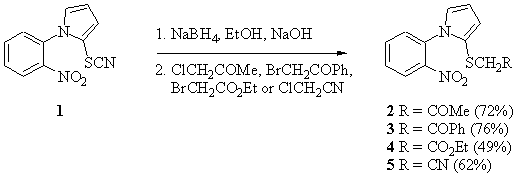
With an extension of this work in mind we decided to exploit the intramolecular capture of in situ generated nitroso species by carbanions and the intramolecular addition of hydroxylamines to carbonyl groups or nitriles in order to effect ring closure by carbon-nitrogen bond formation. To this end, we prepared ketones 2 and 313, ester 4 and nitrile 514by selectively reducing 1-(2-nitrophenyl)-2-thiocyanato-1H-pyrrole 1 with sodium borohydride and then treating the resulting thiol, that was not isolated, with 2-chloroacetone, phenacyl bromide, ethyl bromoacetate or chloroacetonitrile, respectively (Scheme 1).
Scheme 1
A few examples, were intramolecular capture of in situ generated nitroso species is used for the synthesis of fused heterocycles, are given below. Reductive cyclisation of N1-(alkyl or aryl)-2-nitrobenzamides into 2-(alkyl or aryl)-2,3-dihydro-1H-3-indazolones has been accomplished via treatment with zinc dust and sodium hydroxide.15 Milder reaction conditions, zinc dust and ammonium chloride, have been used for the cyclisation of substituted 3-(2-nitrophenoxy)phenols into 3H-phenoxazin-3-ones16 and of ethyl 2-nitrophenylacetate into 4-hydroxy-1,4-benzoxazine-3(4H)-one.17 Recently we reported the reductive cyclisation of (2-nitrophenyl)(1H-pyrrol-2-yl)methanone with zinc and ammonium chloride or sodium hydroxide which gave 5,10-dihydro-pyrrolo[1,2-b]cinnolin-10-one.18
Selective reduction of compounds 2-4 with zinc dust and ammonium chloride in aqueous ethanol from 0oC to room temperature afforded mixtures of the corresponding amines 7, 913 and 11,13 and hydroxylamines 8, 10 and 12 (Scheme 2). No trace of the anticipated pyrrolobenzothiadiazepines 6 was detected. This could be due to the weakly basic reaction conditions that were ineffective in deprotonating the methylene group in compounds 2-4. As a result intramolecular trapping of the transient nitroso group formed during the reduction of compounds 2-4 did not take place. When compounds 2 and 3 were subjected to selective reduction using zinc dust and sodium hydroxide in refluxing aqueous ethanol, a complex mixture was produced in each case that appeared as a streak on TLC. All attempts to separate the components of these mixtures proved unsuccessful.
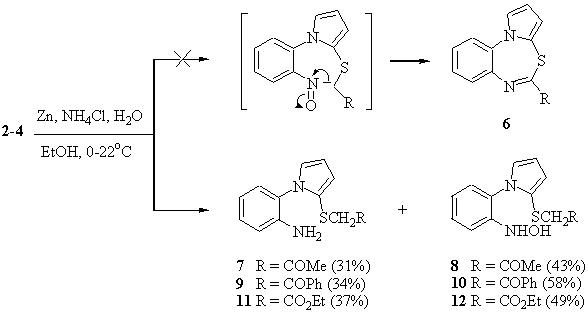
Scheme 2
Oxidation of 2 and 3 to their sulfones would increase the acidity of the methylene hydrogens in these compounds. Compounds 2 and 3 were oxidized smoothly into their corresponding sulfones 13 and 15 by 2-chloroperbenzoic acid (Scheme 3). However, the hoped for reductive cyclisation of 13 and 15 by treatment with zinc and ammonium chloride failed, yielding instead the amine 14 and nitroso compound 16, respectively.

Scheme 3
We anticipated that using a stronger base such as sodium hydroxide in the reduction of sulfone 13, abstraction of the relatively acidic methylene proton should be accelerated and according to the mechanism of Scheme 3, afford the S,S-dioxide derivative of pyrrolobenzothiadiazepine 6 (R=COMe). However heating 13 in aqueous ethanolic sodium hydroxide containing zinc dust yielded a mixture of two new compounds, 1-(2-nitrophenyl)(1H-2-pyrrolylsulfonyl)methane 17 and 1-(2-nitrophenyl)-2-methyl-sulfonylpyrrole 18, in 48% and 43% yield respectively. Another example where nitro groups have been unaffected is the reduction of (2-nitrophenyl)(1-methyl-1H-pyrrolyl)methanols with zinc and sodium hydroxide.17 The structure of 17 was confirmed by its unambiguous synthesis from thiocyanate 1. The latter was alkylated with methyl iodide in the presence of sodium borohydride to give 1-(2-nitrophenyl)-2-methylthio-1H-pyrrole which was then oxidised directly to sulfone 18 by reacting with oxone® in acetone at room temperature. Heating compound 13 in aqueous ethanolic sodium hydroxide gave a mixture of 17 and 18 in 46 and 41% yield, respectively. Furthermore when compounds 17 and 18 were heated in aqueous sodium hydroxide with or without the presence of zinc dust, starting material was recovered unchanged. These results confirm beyond doubt that zinc dust plays no role in the reaction and that the formation of 17 and 18 occur independently from 13. The mechanism of this reaction can be considered as a Truce-Smiles type of transformation and is similar in some respects to the mechanism proposed by Cheeseman and Hawi to explain the rearrangement of methyl 2-{[1-(2-nitrophenyl)-1H-pyrrol-2-yl]thio}acetate into 2,3-dihydro-2-(2-nitrophenyl)-3-oxo-pyrrolo[2,1-b]thiazole. The reaction took place in dimethyl sulfoxide with potassium t-butoxide as base.14
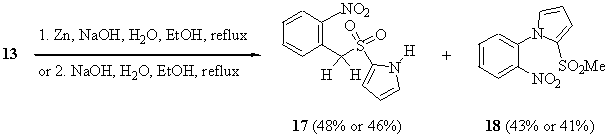
Scheme 4
In order to acquire further insight into the reaction of Scheme 4 it was decided to prepare sulfoxide 19. The reaction of 2 with oxone® in acetone at ambient temperature afforded sulfoxide 19 as a single product in 88% yield (Scheme 5). When 19 was heated in aqueous ethanolic sodium hydroxide containing zinc dust pyrrolylsulfinylmethane 20 was obtained in 68% yield. Repeating the reaction without zinc dust gave 20 in 72% yield.
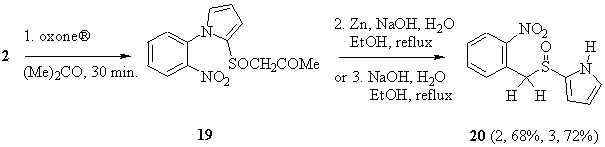
Scheme 5
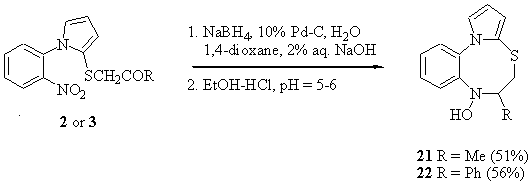
Compounds 2, 3 and 5 were found to be useful precursors to the novel pyrrolo[1,2-a]-[3,1,6]benzothiadiazocin-7-ols 21 and 22, and, pyrrolo[1,2-a][3,1,6]benzothiadiazocine-7-oxide 26, respectively. Thus ketones 2 or 3 were reductively cyclised in the presence of sodium borohydride and 5% palladium-on-carbon to give the corresponding tricycles 21 and 22 in 51 and 56% yield.
Scheme 6
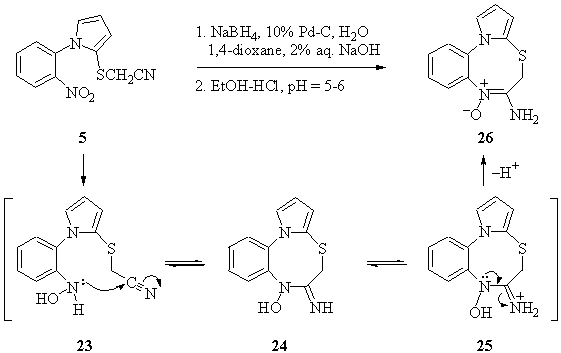
Treatment of nitrile 5 with sodium borohydride and 5% palladium-on-carbon gave tricyclic-N-oxide 26 in 43% yield. The proposed mechanism for this transformation (Scheme 7) involves reduction of 5 into intermediate hydroxylamine 23, intramolecular nucleophilic addition to the nitrile group, protonation of resulting imine 24 to iminium cation 25 and conversion of the later to N-oxide 26 by lone pair electron delocalisation and deprotonation. A similar mechanism can be proposed for the reactions of Scheme 6.
Scheme 7
Conclusion
In summary, it has been shown that substituted pyrroles such as 1-{[1-(2-nitrophenyl)-1H-pyrrol-2-yl]sulfanyl}-acetone is reduced by zinc and ammonium chloride to the corresponding hydroxylamine and amine derivatives, without the observation of any intramolecular interaction. A similar result was obtained with 1-{[1-(2-nitro-phenyl)-1H-pyrrol-2-yl]sulfonyl}acetone where only the corresponding amine was isolated. However treatment of 1-{[1-(2-nitrophenyl)-1H-pyrrol-2-yl]sulfonyl}acetone with zinc and sodium hydroxide gave a mixture of two products possibly resulting from a Truce-Smiles type of transformation and a simple deacetylation. Remarkably, no reduction of the nitro group in these compounds had occurred. Reduction of 1-{[1-(2-nitrophenyl)-1H-pyrrol-2-yl]sulfonyl}-acetone or -1-phenylethan-1-one with sodium borohydride and 5% palladium-on-carbon, a reagent known to convert aromatic nitro compounds to hydroxylamines, triggered intramolecular interaction and gave pyrrolo[1,2-a][3,1,6]benzothiadiazocine derivatives. This novel method of formation of latter ring system was successfully applied to the reductive cyclisation of 2-{[1-(2-nitrophenyl)-1H-pyrrol-2-yl]sulfanyl}acetonitrile.
Acknowledgements: This work was supported by a PENED 95 grant from the General Secretariat of Research and Technology, Athens, which is gratefully acknowledged.
References and Notes
[1] McMahon, J. B.; Gulakowsky, R. J.; Weislow, O. S.; Schultz, R. J.; Narayanan, V. L.; Clanton, D. J.; Pedemonte, R.; Wassmundt, F. W.; Buckheit, R. W., Jr.; Decker, C. D.; White, L.; Bader, J. P.; Boyd, M. R. Antimicrob. Agents Chemother. 1993, 37, 754.
[2] Young, S. D; Amblard, M. C.; Britcher, S, F.; Grey, V. E.; Tran, L. O.; Lumma, W. C.; Huff, J. R.; Schleif, W. A.; Emini, E. E.; O’Brien, J. A.; Pettibone, D. J. Bioorg. Med. Chem. Lett. 1995, 5, 491.
[3] Williams, T. M.; Ciccarone, T. M.; Mactough, S. C.; Rooney, C. S.; Balani, S. K.; Condra, J. H; Emini, E. A.; Goldman, M. E.; Greenlee, W. J.; Kauffman, L. R.; O’Brien, J. A.; Sardana, V. V.; Schleif, W. A.; Theoharides, A. D.; Anderson, P. S. J. Med. Chem. 1993, 36, 1291.
[4] Artico, M.; Silvestri, R.; Stefancich, G.; Massa, S.; Pagnozzi, E.; Musu, D.; Scintu, F.; Pinna, E.; Tinti, E.; La Colla, P. Arch. Pharm. (Weinheim) 1995, 328, 223.
[5] Artico, M.; Silvestri, R.; Stefancich, G.; Massa, S.; Loi, A. G.; Corrias, S.; Piras, G.; La Colla, P.; J. Med. Chem. 1996, 39, 522.
[6] Artico, M.; Di Santo, R.; Costi, R.; Massa, S.; Scintu, F.; Loi, A. G.; De Montis, A.; La Colla, P.; Bioorg. Med. Chem. Lett. 1997, 7, 1931.
[7] Silvestri, R.; Artico, M.; Massa, S.; Stefancich, G.; Congeddu, E.; Putzolu, M.; La Colla, P. Farmaco, 1997, 52, 323.
[8] Artico, M.; Silvestri, R.; Pagnozzi, E.; Stefancich, G.; Massa, S.; Loi, A. G.; Putzolu, M.; Corrias, S.; Spiga, G. M.; La Colla, P. Bioorg. Med. Chem. Lett. 1996, 4, 837.
[9] Silvestri, R.; Pagnozzi, E.; Artico, M.; Stefancich, G.; Massa, S.; La Colla, P. J. Heterocycl. Chem. 1995, 32, 683.
[10] Di Santo, R.; Costi, R.; Artico, M.; Massa, S. J. Heterocycl. Chem. 1995, 32, 1779.
[11] Di Santo, R.; Costi, R.; Artico, M. J. Heterocycl. Chem. 1996, 33, 2019.
[12] Cheeseman, G. W. H.; Hawi, A. A.; Varvounis, G. J. Heterocycl. Chem. 1985, 22, 423.
[13] Cheeseman, G. W. H.; Varvounis, G. J. Heterocycl. Chem. 1987, 24, 1157.
[14] Bruneau, P.; Delvare, C. J. Med. Chem. 1991, 34, 1028.
[15] Bird, C. W.; Latif, M. Tetrahedron 1980, 36, 529.
[16] Sicker, D.; Prätorius, B.; Mann, G.; Meyer, L. Synthesis, 1989, 211.
[17] Kimbaris, ?.; Varvounis, G. Tetrahedron 2000, 56, 9675-9683.
[18] Klaubert, D. H.; Bell, S. C.; Pattison, T. W. J. Heterocycl. Chem. 1985, 22, 333.
[19] Armarego, W. L. F.; Perrin, D. D. Purification of Laboratory Chemicals; Butterworth-Heinemann: Oxford, 1996.