
Proximity effects: The observation by 1H NMR of steric compression of the methano bridge protons of polycyclic norbornanes possessing adjacent carbon, oxygen and nitrogen bridges
Davor Margetic*, Martin R. Johnston, Ronald N. Warrener and Douglas N. Butler
Centre for Molecular Architecture, Central Queensland University, North Rockhampton, 4701, Queensland, Australia, e-mail: [email protected]
Received: 27 July 2001 / Uploaded 7 August 2001
Abstract
Proximity effects of neighbouring heteroatom bridges (oxygen, nitrogen) cause steric compression shifts in the 1H NMR chemical shifts of the bridge methano protons in fused norbornanes. This observation provides a simple 2D NMR method for elucidating the stereochemical outcome of cycloaddition reactions that produce fused norbornane structures.
Introduction
The construction of polycyclic structures consisting of fused norbornanes is one of the main themes of our reseach. The development of the ACE coupling protocol,[1] its aza- counterpart[2] as well as the s-tetrazine based coupling methodology[3] has allowed us to synthesize a selection of large polynorbornane structures such as those shown in Figure 1.
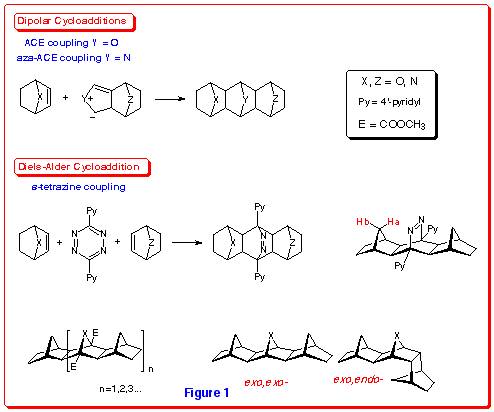
In principle, from these coupling protocols there are four different possible isomers, two isomers resulting from exo- addition (exo,exo- and exo-endo- as depicted in Figure 1) while endo- addition would yield two different isomers (not shown). In practice, the isomers that result from endo- attack are rarely observed. While the stereochemistry of exo,exo- adducts can be determined on the basis of molecular symmetry and the corresponding simplified 1H NMR spectra, the determination of the stereochemistry of any unsymmetrical adducts often requires time-consuming combinations of 2D NMR experiments. Thus for our ACE-coupling reactions, we required an easy spectroscopic tool for stereochemical assignments of the polynorbornanes produced, preferably a simple 1D 1H NMR spectrum for each required assignment. This would then be an extension of the method employed in the s-tetrazine coupling chemistry where we have used the upfield shift of the inward-facing methylene bridge proton resonances when the proton is proximate to the shielding effect of diazo bridge (Figure 1). [4]
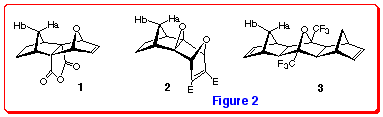
The positioning of methano protons in close proximity to heteroatoms has been reported in [C,O]polynorbornane compounds in the literature. For instance molecules of type 1, prepared by Bartlett,[5] have the norbornane skeleton fused to a 7-oxanorbornene moiety (Figure 2) the geometry of which was supported by an X-ray crystal structure. Unfortunately however, the presence of the anhydride ring at the bridgehead endo- does not allow the characteristic W-coupling (see below) between methylene and endo- protons to be seen and hence an absolute assignment of Ha/Hb was not possible. Furthermore compound 2, which is similar to our systems, was reported by Vogel[6] but without NMR resonance assignments. Finally [C,O]polynorbornane 3,similar to our ACE coupling products, has been prepared by 1,3,4-oxadiazole coupling however no spectroscopic details were reported.[7,8]
Results and discussion
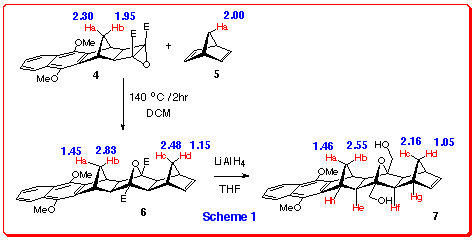
Our initial investigations utilised benzo-polynorbornane 7 as a model system since all the types of protons of interest were present in this structure, and the molecule does not have high symmetry. The preparation of 7 is outlined in Scheme 1 and consists of a BLOCK coupling protocol using cyclobutane epoxide 4 with norbornadiene 5 leading to the formation of adduct 6. The bridgehead esters were subsequently reduced to alcohols using LiAlH4 in THF to give 7.
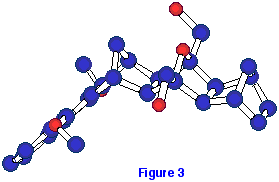
Single crystals of 7 were grown from methanol and single crystal X-ray crystallography revealed the formation of the linear exo,exo- isomer (Figure 3).
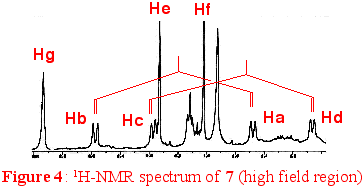
The linear (or exo,exo-) structure of 7 can also be elucidated using 1H NMR spectroscopy. The methano proton resonances of norbornadiene 5 appear at 2.00 ppm, while the corresponding protons in epoxide 4 resonate at 1.95 and 2.30 ppm (Scheme 1). Characteristic signals in the 1H NMR spectrum of 7 are four doublets (two AB pairs) which belong to the two methano bridgehead protons (Ha, Hb, Hc and Hd), and which can be seen in the high field region of the spectrum (Figure 4). The scalar coupling between geminal pairs indicated which doublets form AB pairs, however the 1D spectrum was not sufficient to determine in which ring (norbornene or benzonorbornene) each methano group was situated. Thus our attention was directed toward 2D COSY and NOESY experiments as shown in Figure 5 and 6 respectively.
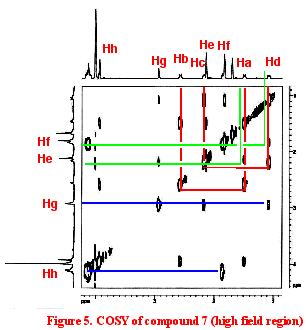
The COSY spectrum confirmed the grouping of methano AB pairs that had been assigned from the 1D coupling constants (red lines, Figure 5). Further, the COSY plot revealed a correlation between the olefinic protons (not shown) and the bridgehead protons Hg. These Hg protons further correlated with the upfield methylene AB pair (d 2.16 and 1.05) identifying these as Hc and Hd (blue line, Figure 5). In a similar manner, the benzylic bridgehead protons Hh (Scheme 1) correlated with the downfield methano AB pair (1.46 and 2.55 ppm) thus identifying these as Ha and Hb (blue line, Figure 5). Within these sets of AB pairs, W-couplings[9] of the methano protons with endo protons (green lines, Figure 5) reveal that the protons facing oxygen viz. Hc and Hb are those at lower fields at 2.16 and 2.55 ppm, respectively.
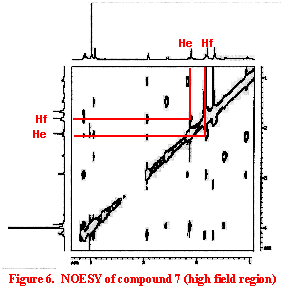
Finally, the linear structure was again supported by a NOESY experiment (Figure 6), with nOe effects being observed (red lines, Figure 6) between endo protons He and Hf (located at 2.12 and 1.82 ppm, respectively). Having umambigiously assigned all the polynorbornane proton resonances using a combination of 1D and 2D NMR experiments, we were able to conclude that a simple tool for structural assignments would be the use of the chemical shifts of methano protons in these types of polynorbornanes. Specifically, those facing the oxygen bridge are shifted downfield, while the other half of the methano proton pairs are shifted to higher field. Thus, the proximity of the oxygen atom causes a large splitting of methano AB pairs. This effect may be attributed to steric comperession (or steric deshielding) of the methano proton into the electron density surrounding the adjacent 7- heteroatom (see calculation section below). A similar explanation involving steric comperession of methano protons into a pi-electron cloud was forwarded by Wege[10] and Battiste[11] and used later by others[12,13] to explain the observed chemical shifts in several bent norbornene adducts.
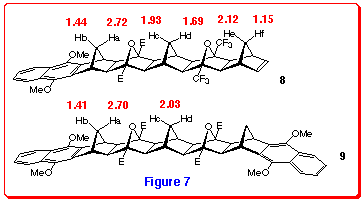
Having formulated the concept of utilising methano bridge chemical shifts as a stereochemical identifier, we analysed 1H NMR spectra of a series of [C,O]polynorbornane adducts that we had already prepared. We found that in adducts containing an adjacent bridge oxygen, the methano proton resonances at high field lie within a range of 1.03 - 1.59 ppm, while the low field resonances are between 2.08 and 2.72 ppm. Some examples are collected in Figure 7 and reveal that the trend is indeed evident. Thus, there is a 1.14 - 1.64 ppm difference in the chemical shifts of the two AB methano doublets (average value from 24 different ACE adducts), where corresponding methano proton splittings in norbornene and benzonorbornene are 1.12 and 0.90 ppm.
It is interesting to note that the steric compression effect is not additive. On the contrary, the effect of positioning methano proton pairs between two oxygen atoms in these polynornornane systems results in a zero net effect, as can be seen from two examples 8 and 9 depicted in Figure 7.
Cyclopropyl series
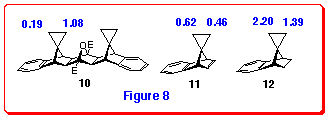
The effect on proton chemical shift of steric compression against an oxygen atom is also observed in the case when polynorbornanes contain cyclopropyl groups in the 7- position. In the case of 10 (Figure 8), the symmetry of the 1H NMR spectra as well as X-ray crystallography both support the linear structure. However, due to a lack of W-coupling, which is crucial for the absolute methano proton assignment, we cannot exactly assign which methano proton faces the oxygen atom and which one is on the outer side. Evidence to support our assignment is based on chemical shift calculations (see below) where the methano protons facing the oxygen bridge are predicted to be at higher chemical shift.
Nitrogen series
The next series of compounds to be examined contained a nitrogen heteroatom in the 7- position of the polynorbornane structure. Such compounds were synthesised as part of a program investigating the effects of neighbouring groups on the hybridisation of the nitrogen atom and were synthesised using the aza-ACE reaction.[2]
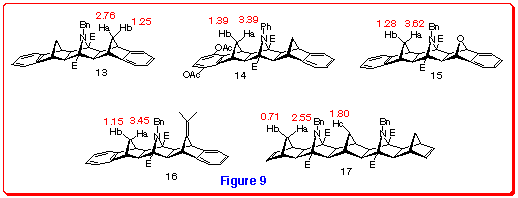
Examination of their 1H NMR spectra revealed a similar trend to that observed previously for the methano proton resonances (Figure 9). Once again, steric compression of the methano protons against the nitrogen atom causes the resonances to have increasingly separate chemical shifts, with one moving to higher field (the one facing nitrogen) and the other to a lower field. The methano protons that resonate at a higher magnetic field are within the range 0.71 - 1.28 ppm, while the lower field AB falls in the range 2.76 - 3.62 ppm. In comparison to the oxygen series of compounds, the lower field protons are more deshielded by 0.7 - 0.9 ppm. Furthermore, the separation between the AB pairs of resonances are larger than in oxygen series, with the highest being 2.34 ppm. It is important to note in the nitrogen series that the steric compression effect is not as clear due to the dynamic properties of these molecules with respect to nitrogen inversion. Finally, the replacement of the benzyl substituent with phenyl also causes changes in chemical shifts (see examples 13 and 14, Figure 9).
Calculations
The semiempirical method PM3 was used to optimize the geometries of all studied molecules, while a B3LYP/6-31G*/GIAO//PM3 approach was used to estimate the nuclear magnetic shielding tensors.
Inspection of the results reveals that the calculated values are 0.5 - 0.7 ppm further downfield than the experimental values. In the oxygen series however, the splitting between the two halves of the AB methano pair is predicted to be very close to experiment (1.14 - 1.64 ppm experimentally, 1.16 - 1.22 ppm calculated). Also the calculations showing that the compressed proton facing oxygen is always on the low field, is consistent with that observed experimentally. In the case of molecule 7, calculations also predict which methano proton pair is at the lower and which is at the higher field in accord with the experimental observations.
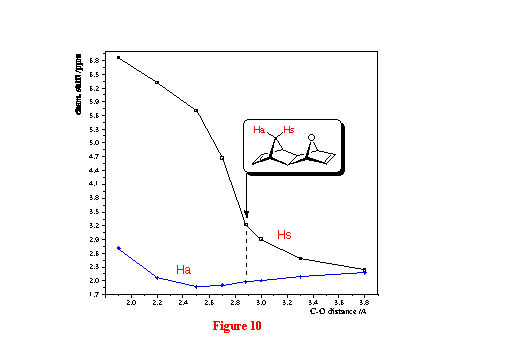
A plot of predicted chemical shifts for the methano protons against the interatomic distance between the methano carbon atom and oxygen bridge is shown in Figure 10. The data reveals that a decrease in the distance between the atoms causes a larger deshielding of the neighbouring syn- methano protons, while chemical shifts of anti- methano protons are not as affected.
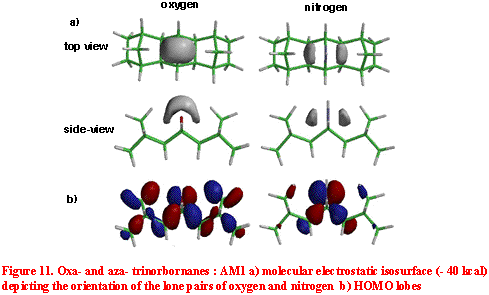
The AM1 generated molecular electrostatic isosurface revealing the lone pair positions within an oxa and aza- trinorbornane is shown in Figure 11 along with the HOMO orbitals. Based on these results the lone pair in the oxygen series is expected to have larger effect on the methano protons than in the nitrogen series, opposite to the experimental observations. However, examination of the HOMO orbitals within each series clearly reveals larger lobes directed toward the methano protons in the aza- derivatives which should result in larger steric compression effects. Thus, we can speculate that in these trinorbornane series of compounds the steric compression effects are caused by the HOMO orbitals containing the lone pairs of electrons. The lower lying MOs have major contributions from the sigma skeleton of the trinorbornane far removed from the methano protons.[14]
The above conclusion is further supported by a Mulliken population analysis calculation to determine the amount of secondary orbital interaction (electron density) between the methano proton and the adjacent 7- heteroatom. A larger interaction was found in the aza-trinorbornane as compared to the oxa- derivative in line with the experimentally observed methano proton chemical shifts.
Conclusion
We have identified a simple 1D 1H NMR method for assigning the stereochemical outcome of ACE coupling reactions to produce polynorbornanes. The method is based on chemical shift differences between methano bridge protons as a result of steric compression against the electron density of the adjacent heteroatom. The method has also been successfully applied to aza-polynorbornane systems.
The proximal effects of oxygen on the 13C chemical shifts of the methano carbon atom are still under investigation and these results will be reported in due course. Initially our results have the same trend as reported by Irikawa. [15]
Acknowledgement
We thank the Australian Research Council for funding and MRJ thanks CQU for the provision of a Research Advancement Award.
Experimental
NMR spectra were acquired on either a Bruker AMX300 (300 MHz) or Bruker DRX400 (400 MHz) using standard Bruker pulse programs. Unless otherwise stated, spectra were recorded at 303 K using deuterated CDCl3 as the solvent with tetramethylsilane (TMS) as the internal standard. Chemical shifts (d ) are reported as parts per million (ppm) with respect to TMS.
Preparation of 4. A solution of diester 3 (50 mg, 0.099 mmol) in dry THF (5 ml) was added dropwise to the slurry of LiAlH4 (11 mg, 0.299 mmol) in dry THF (10 ml) at 0 oC in a nitrogen atmosphere. The ice bath was then replaced by oil bath and refluxed for 5 hours. The excess of LiAlH4 was carefully destroyed by addition of solid Na2SO4.10H2O at 0 oC. When the evolution of gas ceased, it was filtered off and solvent evaporated in vaccuo. Radial chromatography (petroleum ether - ethyl acetate) afforded a colourless solid 4 (32 mg, 72 %, m.p. 252 - 254 oC).
1H (CDCl3): 1.06 (1H, d, J=8.12 Hz); 1.46 (1H, d, J=9.20 Hz); 1.82 (2H, s); 2.12 (2H, s); 2.16 (1H, d, J=8.12 Hz); 2.56 (1H, d, J=9.12 Hz); 2.93 (2H, s); 13C (CDCl3): 41.46; 41.86; 42.11; 42.63; 52.17; 54.76; 60.16; 61.64; 86.71; 122.04; 125.16; 127.91; 136.06; 139.27; 143.89. HRMS Calcd. for C28H30O5: 446.2093, found 446.2097. Crystals suitable for X-ray analysis were obtained from methanol.
References
1. Warrener R. N.; Schultz, A. C.; Butler, D. N.; Wang, S.; Mahadevan, I. B.;
Russell, R. A. Chem. Commun. 1997, 1023.
2. Butler, C. N.;
Malpass, J. R.; Margetic, D.; Russell, R. A.; Sun, G.; Warrener, R. N.
Synlett 1998, 588.
3. Warrener, R. N.; Margetic, D.; Russell,
R. A. Synlett 1998, 585.
4. Battiste postulated that the
syn- proton in systems such as molecule 18 
is deshielded compared to the
corresponding anti proton, and that this shift may be explained on the
basis of the steric compression of that proton against the p cloud of the double bond. An alternative explanation was
offered by Edman and Simmons who suggested that the syn- proton may lie
in the deshielding rather than in the shielding zone of the double bond (Edman,
J. R.; Simmons, H. E. J. Org. Chem. 1968, 33, 3808.)
5.
Bartlett, P. J.; Combs. Jr., G. L.; Thi Le, A.-X.; Watson. W. H.; Galloy, J.;
Kimura, M. J. Am. Chem. Soc. 1982, 104, 3131.
6.
Hagenbuch, J.-P.; Vogel, P.; Pinkerton. A. A.; Schwarzenbach, D. Helv. Chim.
Acta, 1981, 64, 1818.
7. Seitz, V. G.; Wassmuth, H.
Chem. Zeit. 1988, 112, 80. These same authors also report a
thiadiazole adduct, which would make an excellent comparison for the oxygen and
nitrogen series of compounds.
8. Vasiliev, N. V.; Lyashenko, Yu. E.;
Galakhov, M. V.; Kolomiets, A. F.; Gontar, A. F.; Sokolskii, G. A. Khim.
Geterotsikl. Soedin.1989, 1, 95.
9. Laslo, P.; Schleyer,
P. v. R. J. Am. Chem. Soc. 1964, 86, 1171; Snyder, E. I.;
Franzus, B. J. Am. Chem. Soc. 1964, 86, 1166; 4J or
W-coupling in norbornane systems such as 19 is long range coupling of
methano proton Ha with endo proton He (as depicted in blue). 
10. McCulloch, R. K.; Rye,
A. R.; Wege, D. Aust. J. Chem. 1974, 27, 1929.
11.
Haywood-Farmer, J.; Malkus. H. Battiste, M. A. J. Am. Chem. Soc.
1972, 94, 2209.
12. Mantzaris, J; Weissberger, E. J. Org.
Chem. 1974,39(5), 726. The stereochemistry of the Diels-Alder
adduct of 2 moles of cyclopentadiene and 1 mole of norbornadiene demonstrated
steric deshielding.
13. Aue, D. H.; Reynolds, R. N. J. Org. Chem.
1974, 39(15), 2315. The products are highly strained from
steric compression as indicated from large downfield shifts in the proton NMR
spectra.
14. In the case of benzo-, naptho- or norbornene terminated systems
the HOMO is not located on the central bridge heteroatom but on the p- system. In these instances, the major effect on the
methano protons is from the lower lying MO which has a large contribution from
the heteroatom lone pair of electrons.
15. Irikawa, H.; Adachi, N.
Heterocycles 2000, 53(1), 135.
(E)-5,5'-bis(2-methylphenyl)- and
(E)-5,5'-bis(2,4,6-trimethylphenyl)-3,3'-bifuranylidene-2,2'-diones were
converted into the nitrogen analogues. Steric compression due to coplanarity of
the aryl rings causes a deshielding of a 1H-NMR signal by ca. 0.6
ppm, and a shielding of a 13C-NMR signal by ca. 5 ppm.