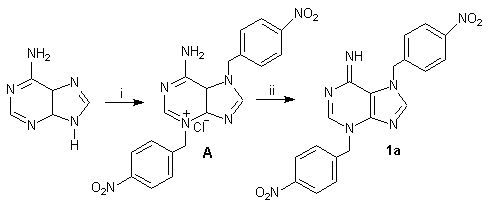
i: p-nitrobenzylchloride (2 eq.), DMF, microwave
ii: EtOH, NaOH (0.2 N)
Scheme 1
ALKYLATION OF SOME PYRIMIDINE AND PURINE DERIVATIVES IN THE ABSENCE OF SOLVENT USING MICROWAVE-ASSISTED METHOD
Hortensia Rodrígueza*, Rolando Péreza , Margarita Suáreza*, Anabel Lamb, Nilda Cabralesa and André Loupyc*
a)Laboratorio de Síntesis Orgánica. Facultad de Química.
Universidad de La Habana. 10400 La Habana. Cuba. E-mail: [email protected]
b) Laboratorio de Ingeniería en Zeolitas.
Instituto de Materiales y Reactivos, Universidad de La Habana. 10400 La Habana.
Cuba
c)Laboratoire des Réactions Sélectives sur Supports. CNRS
UMR 8615. Université Paris-Sud. Bâtiment 410, 91405 Orsay. France.
Received: 15 August 2001 / Uploaded 22 August 2001
INTRODUCTION
Several works have been reported on the alkylation of N-containing heterocycles. In this regard microwave (MW) activation have been successfully applied in the synthesis of such derivatives.1-3 In previous works4 we have described the N-alkylation of azoles with 4-bromophenacyl bromide under microwave irradiation under solvent-free conditions, the results obtained showed high yields and selectivity. Following our interest in this topic, pyrimidine and purine alkylated derivatives seem to be attracting structures in connection with the investigation of carcinogenesis5 and as an access to therapeutic agents such as antiviral adenine derivatives6 and antimicotic pyrimidine derivatives.7
The most frequently used method for the alkylation of the purine and pyrimidine derivatives is a direct N-alkylation by a suitable functionalized alkyl derivative, in the presence of a base,8 potassium fluoride on alumina9 or tetrabutylammonium fluoride.10 N-alkylation of these derivatives with alkyl halides have also been performed under solvent-free conditions : theophylline, for example, was efficiently alkylated without solvent in the presence of catalytic amounts of quaternary ammonium salts.11
Phase Transfer Catalysis (PTC) was in addition applied successfully to a great variety of N-alkylation reactions performed through anionic activation with12 or without solvent.13,14 Liquid/liquid15 and solid/liquid16 PTC have been used in the alkylation of uracil, adenine and other N-containing heterocyclic compounds.
We describe here an easy and efficient microwave-assisted method to obtain N-alkylated derivatives of adenine 1, guanine 2 and 6-aminothiouracil 3, under solvent-free conditions, using different alkylating agents. In the case of 6-aminothiouracil we used alternately the coupling of microwave irradiation and PTC methods.3,17
RESULTS AND DISCUSSION
Alkylation of adenine using a solvent-free microwave-assisted method was performed using catalytic amounts of DMF. This polar molecule is added to improve energy transfer and to allow higher temperatures.18-21 The reaction led to the dialkylated product as a salt A which is subsequently extracted with ethanol and washed with NaOH solution to obtain the 3,7-disubstituted adenine 1a with 16 and 74 % yield using 1:1 eq. and 1:2 eq. respectively (Table 1 and Scheme 1).
i: p-nitrobenzylchloride (2 eq.), DMF, microwave
ii: EtOH, NaOH (0.2 N)
Scheme 1
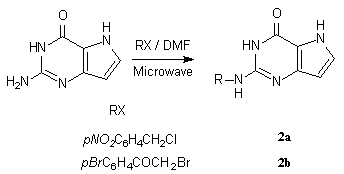
The N-alkylation of guanine with 4-nitrobenzyl chloride (2a) and 4-bromophenacyl bromide (2b) in equimolecular amount, under similar conditions (Scheme 2), occurs on the amino group on C2, in moderate yield (Table 1).
Scheme 2
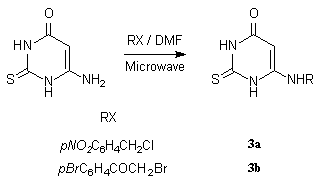
The results obtained in the alkylation of 6-aminothiouracil showed quantitative yields in the corresponding N6-monosubtituted thiouracil derivatives (See Table 1 and Scheme 3).
Scheme 3
Table 1. Alkylation of pyrimidine and purine derivatives under
microwave
irradiation in dry media (power 665 W).
|
|
(min) |
(° C)a |
(%) |
|
|
|
|
|
|
|
|
|
|
|
|
|
|
|
|
|
|
|
|
|
|
|
|
|
All reactions were followed by TLC and the products were characterized by 1H, 13C-NMR and mass spectroscopic studies.
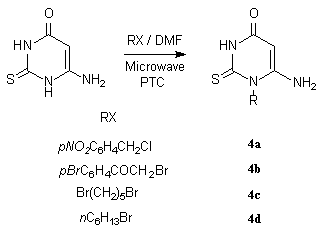
The alkylation of 6-aminothiouracil using microwave irradiation under PTC conditions gave the N1-alkyl-thiouracil derivatives with excellent yields (Scheme 4 and Table 2).
Scheme 4
The results were very satisfactory taking in account the short reaction times and the good yields in N-alkylated products. In order to check the possibility of intervention of specific (non-purely thermal) MW effects, the syntheses of these compounds were performed, changing only the heating mode, using a thermoregulated oil bath for the same reaction times and temperatures as involved in microwave experiments. In all cases no reaction was detected by tlc. It is evident here that specific "non thermal" effect produced by microwave is of prime importance as no reaction occurred under the same conditions (time and temperature) by conventional heating.
|
|
|
|
(%) |
|
|
|
|
|
|
|
|
|
|
|
|
|
|
|
|
|
|
|
|

Scheme 5
Table 3. Total atomic charges calculated for the most relevant atoms for adenine (1) and guanine (2).25-28
|
|
|
|
|
|
|
|
|
|
|
|
|
|
|
|
|
|
|
|
|
|
|
|
|
|
|
|
|
|
|
|
|
|
|
|
|
|
|
|
|
|
|
|
The observed regioselectivity of adenine occurring on N3 and N7 atoms and on exocyclic N atom of guanine is consistent with the consideration of atomic charges on the relevant atoms of these molecules as previously reported from ab initio calculations (Table 3).
The N3 and N7 atoms have the most important negative charge in adenine as well as the N10 (exocyclic) in guanine. These results can explain the attack of these atoms by an electrophile under charge-controlled reaction.
In the case of 6-amino-2-thiouracil, the difference in regioselectivity obtained by the two methods employed for the synthesis of N-alkylated derivatives was a consequence of the basic medium. When the reaction is performed in the absence of a base, the selectivity is clearly different from the one observed from the anionic species (PTC conditions). Alkylation occurs selectively at position 6 on the neutral 6-aminothiouracil and at position 1 from its anion. Such a change in selectivity was already described in the case of alkylations of some azoles according to basic or neutral conditions.29
We have tried to justify these effects on the selectivity of alkylation by considering a theoretical approach taking into account the orbital coefficients on the nitrogen atoms of 6-aminothiouracil (3). Some calculations have been performed using the HF/6-31G** ab initio program (Gaussian 94).30
A previous calculation has allowed to suggest the 3(A) geometry to be more stable than its tautomer 3(B) (imino form) by 1.50 kcal/mol. (cf. tautomerism equilibrium as depicted in Scheme 6).
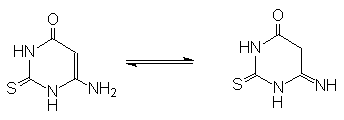
3 (A) 3 (B)
Scheme 6
In order to explain electrophilic attack of 3 (A) or its anion 3
(-), the values of atomic orbital coefficients are given in the highest
occupied levels (Table 4).
Table 4. HF/6-31G** orbital coefficients of the highest energy levels of the 6-amino-2-thiouracil (3A), 6-imino-5H-thiouracil (3B) and the 6-aminothiouracil anion (3(-)).
|
|
|
|
|
|
|
|
Energy (Hartrees) |
0.37 0.42 |
0.33 0.35 0.37 | |||
|
C2 N3 C4 C5 C6 N7 |
0.18 0.25 0.02 0.38 0.21 0.26 |
0.01 0.39 0.01 0.07 0.23 0.42 |
0.11 0.23 0.02 0.37 0.15 0.12 |
0.18 0.21 0.02 0.01 0.07 0.20 |
0.02 0.13 0.05 0.37 0.05 0.04 |
Taking into account the values of the orbital coefficients in the near highest energy level (Orbital 35) for the neutral molecule, we would suggest that this orbital takes part in this reaction, justifying the regioselectivity (attack by N7). The N7 orbital atomic coefficient is important in this orbital, suggesting thus a subjacent orbital contribution of the reaction, whereas the highest coefficient in the HOMO orbital (orbital 37) lies on N1 atom.
On the other hand, the alkylation reaction in the 6-aminothiouracil anion has to be favored by the N1 and C5 atoms, which have the highest orbital coefficients in the HOMO.
In the same way, the atomic charge of the most relevant atoms was calculated and is reported in Table 5. In the 6-aminothiouracil N1, N3 and N7 atoms have the most negative charge values. The behavior is the same for 6-imino-5H-thiouracil (3B) and 6-aminothiouracil anion. In all cases, the atomic charge in C5 is significantly lower than on N atoms. These values could explain, for the anion, the attack by the nitrogen atoms and to reject the possible attack by the C5 atom.
Table 5. Total atomic charges calculated for the most relevant atoms.
|
|
|
|
|
|
|
|
|
|
|
|
|
|
|
|
|
|
|
|
|
|
|
|
|
|
|
|
|
|
|
|
|
|
|
|
|
|
|
|
In summary, the procedure described here, in high yields, does only require the use of a small amount of solvent within very short reaction times and with simplified and safe work-up. It constitutes a clear improvement and involves "green chemistry" techniques.
EXPERIMENTAL PART
Starting materials came from commercial sources. Melting points were determined on an Electrothermal 9100 apparatus and are uncorrected. The reactions were carried out in a Sanyo domestic microwave oven, which allows the selection of output power up to 800 Watts. Tlc analyses were run on 60 F254 silica gel chromatoplates from Merck in a mixture of n-hexane:ethyl acetate 4:1 as eluent. 1H-NMR spectra were recorded on a Bruker AC 250 using TMS as an internal standard and DMSO-d6 as solvent. Mass spectra were obtained with a Hewlett Packard 5890 spectrometer. Microanalyses were performed by the Servicio de Microanálisis of Centro de Ingeniería Genética y Biotecnología. HF/6-31G** calculations were carried out in order to determine the orbital coefficients of the highest occupied molecular orbitals and the atomic charges in 6-aminothiouracil and its tautomer using Gaussian 94 program.30 Previously, MP2/6-31G** calculations were done in order to optimized the structure of the molecules.
Procedure to obtain 3,7-(4-nitrobenzyl)adenine: 2.5 mmol of adenine (1), (2.5 or 5.0) mmol of alkylating agent and 1 mmol of DMF, were smoothly mixed and placed inside a pyrex-glass open vessel and irradiated in a domestic microwave oven. When the irradiation was stopped, the final temperature was measured by introducing a glass thermometer into the reaction mixture and homogenizing it in order to obtain a temperature value representative of the whole mass. The mixture was extracted with ethanol (3x10 mL). The extract is evaporated under vacuum and the final products obtained by washed with solution of NaOH (0.2 N). The resulting solid was filtered off, conveniently dried and recrystallized of water .
3,7-bis(4-nitrobenzyl)adenine 1a: mp: 258-260 ° C; nmax (KBr)/cm-1:3100, 1662, 1508, 1348; 1H-NMR (DMSO-d6) d , (ppm): 5.6 (s, 4H), 8.0 (br, NH), 7.7 (d, J = 8.7 Hz, 2H), 8.19 (d, J=8.7 Hz, 2H), 8.6 (s, 1H, H-8), 9.1 (s, 1H, H-2); 13C-NMR (DMSO-d6) d , (ppm): 51.6 (C10, C15), 116.7 (C5), 123.5 (C13, C13’, C18, C18’), 128.9 (C12, C12’, C17, C17’), 139.5 (C8), 142.2 (C16), 145.0 (C14), 147.1 (C19), 148.0 (C11), 151.7 (C2), 153.5 (C4), 153.7 (C6); ms (m/z): 405 M+, 269, 223. Anal. Calcd. for C19H15N7O4 (405.37): C, 56.30; H, 3.72; N, 24.19. Found: C, 56.51; H, 3.87; N, 24.42.
3,7-bis(4-bromophenacyl)adenine 1b: mp: 286-287 ° C; nmax (KBr)/cm-1:3320, 2860, 1825, 1620; 1H-NMR (DMSO-d6) d , (ppm): 5.5 (s, 4H), 8.0 (br, NH), 7.8 (d, J = 8.4 Hz, 2H), 8.1 (d, J=8.4 Hz, 2H), 8.6 (s, 1H, H-8), 9.1 (s, 1H, H-2); 13C-NMR (DMSO-d6) d , (ppm): 52.3 (C10, C16), 115.8 (C5), 128.9 (C21), 130.4 (C14, C14’, C20, C20’), 132.1 (C18), 132.8 (C15), 134.1 (C13, C13’, C19, C19’), 136.2 (C12), 139.4 (C8), 152.0 (C2), 153.4 (C4), 153.7 (C6) 188.5 (C11), 188.8 (C17); ms (m/z): 529/531 M+, 331/332, 133. Anal. Calcd. for C21H15 Br2N5O2 (529.19): C, 47.66; H, 2.86; N, 13.23. Found: C, 47.78; H, 2.95; N, 13.41.
3,7-bis(hexyl)adenine 1c: mp: 218-219 ° C; 1H-NMR (DMSO-d6) d , (ppm): 0.5 (t, 3H), 0.7 (t, 3H), 0.9-1.7 (m, 16H), 4.6 (t, 2H), 4.8 (t, 2H), 7.8 (br, NH), 8.5 (s, 1H, H-8), 9.1 (s, 1H, H-2); 13C-NMR (DMSO-d6) d , (ppm): 12.9 (C21), 13.1 (C15), 20.5 (C14), 20.9 (C20), 21.6 (C11), 21.9 (C17), 27.5 (C12), 28.1 (C18), 28.3 (C13), 28.9 (C19), 29.5 (C10), 30.2 (C16), 116.6 (C5), 139.8 (C8), 151.5 (C2), 153.8 (C4), 154.2 (C6); ms (m/z): 303 M+, 218, 118. Anal. Calcd. for C17H29N5 (303.46): C, 67.29; H, 9.63; N, 23.08. Found: C, 67.36; H, 9.72; N, 23.17.
General procedure to obtain N2-(monoalkyl)guanines: 2.5 mmol of guanine (3), 2.5 mmol of the alkylating agent and 2.5 mmol of DMF, were smoothly mixed and placed into a pyrex-glass open vessel and irradiated in a domestic microwave oven. When the irradiation was stopped, the final temperature was immediately measured by introducing a glass thermometer into the reaction mixture and homogenizing it in order to obtain a temperature value representative of the whole mass. The mixture was extracted with the adequate solvents (3x10 mL). The extract is evaporated under vacuum and the final products obtained by washing with acetone (3x10mL). The remaining solids were filtered off, conveniently dried and recrystallized of water:methanol (2:1).
N2-(4-Nitrobenzyl)guanine 2a: mp: 263-264 ° C; 1H-NMR (DMSO-d6) d , (ppm): 5.6 (d, 2H), 7.6 (d, J=8.6 Hz, 2H), 8.2 (d, J=8.6 Hz, 2H), 8.8 (s, 1H, H-8); 13C-NMR (DMSO-d6) d , (ppm): 46.3 (C11), 123.7 (C14,14’), 128.8 (C5), 129.2 (C8), 129.3 (C13,13’), 136.7 (C4), 146.1 (C15), 149.7 (C12), 153.1 (C6), 155.0 (C2).Anal. Calcd. for C12H10N6O3 (286.25): C, 50.35; H, 3.52; N, 29.36. Found: C, 50.41; H, 3.60; N, 29.42.
N2-(4-Bromophenacyl)guanine 2b: mp: 293-294 ° C; nmax (KBr)/cm-1:3330, 2870, 1710, 1650; 1H-NMR (DMSO-d6) d , (ppm): 5.4 (d, 2H,), 7.05 (br, NH), 7.8 (d, J=8.4 Hz, 2H), 8.0 (d, J=8.4 Hz, 2H), 8.8 (s, 1H, H-8), 13C-NMR (DMSO-d6) d , (ppm): 51.5 (C11), 128.9 (C8), 129.0 (C5), 130.1 (C16), 130.3 (C15,15’), 131.9 (C13), 132.5 (C14,14’), 136.9 (C4), 153.2 (C6), 156.0 (C2), 189.9 (C12); ms (m/z): 347/349 M+, 151, 81/82. Anal. Calcd. for C13H10BrN6O (346.17): C, 45.11; H, 2.91; N, 24.28. Found: C, 45.32; H, 3.07; N, 24.46.
N2-hexylguanine 2c: mp: 182-183 ° C; nmax (KBr)/cm-1:3310, 3230, 1750, 1560;1H-NMR (DMSO-d6) d , (ppm): 0.6 (t, 3H), 0.9-1.5 (m, 8H), 4.3 (t, 2H), 7.0 (br, NH), 8.9 (s, 1H, H-8); 13C-NMR (DMSO-d6) d , (ppm): 12.8 (C16), 13.4 (C15), 22.1 (C12), 26.8 (C13), 28.0 (C14), 31.0 (C11), 78.4 (C5), 161.7 (C6), 163.5 (C4), 178.2 (C2); ms (m/z): 235 M+, 150, 135. Anal. Calcd. for C11H17N5O (235.29): C, 56.15; H, 7.28; N, 29.76. Found: C, 56.33; H, 7.42; N, 29.89
General procedure to obtain N6-monoalkyl thiouracil: 2.5 mmol of 6-aminothiouracil 3, 2.5 mmol of 4-nitrobenzyl chloride and or 4-bromophenacyl bromide and 2.5 mmol of DMF, were smoothly mixed and placed into a pyrex-glass open vessel and irradiated in a domestic microwave oven. When the irradiation was stopped, the final temperature was measured by introducing a glass thermometer into the reaction mixture and homogenizing it in order to obtain a temperature value representative of the whole mass. The mixture was extracted with the adequate solvents (3x10 mL). The extract is evaporated under vacuum, washed with acetone, filtered and recrystallized of ethanol.
N7-(4-nitrobenzyl)thiouracil 3a: mp: 186-187 ° C; nmax (KBr)/cm-1:3220, 2840, 1530, 1370; 1H-NMR (DMSO-d6) d , (ppm): 4.4 (s, 2H, CH2), 5.6 (s, 1H, H-5), 7.5 (br, NH-7), 7.7-8.2 (m, 4H, C6H4NO2), 11.9 (br, NH-1/NH-3); 13C-NMR (DMSO-d6) d , (ppm): 32.9 (C8), 81.2 (C5), 123.5 (C11, C11´), 130.8 (C10,C10´), 145.9 (C12), 146.7 (C9), 155.1 (C6), 163.5 (C4), 174.5 (C2); ms (m/z): 278/279 M+, 144, 122. Anal. Calcd. for C11H10N4O3S (278.29): C, 47.48; H, 3.62; N, 20.13. Found: C, 47.56; H, 3.77; N, 20.32.
N7-(4-bromophenacyl)thiouracil 3b: mp: 199-201 ° C; nmax (.KBr)/cm-1:3310, 2810, 1824, 1560; 1H-NMR (DMSO-d6) d , (ppm): 4.5 (s, 2H), 5.6 (s, 1H), 7.5 (br, NH-7), 7.7 (d, J=8.5 Hz, 2H), 8.0 (d, J=8.4 Hz, 2H), 11.9 (br, NH-1/ NH-3); 13C-NMR (DMSO-d6) d , (ppm): 78.1 (C8), 81.0 (C5), 127.9 (C13), 130.4 (C12, C12´), 132.0 (C11, C11´), 134.5 (C10), 154.9 (C6), 163.2 (C4), 174.4 (C2), 192.0 (C9); ms (m/z): 341/342 M+, 308, 185. Anal. Calcd. for C12H10BrN3O2S (341.20): C, 42.24; H, 2.95; N, 12.31. Found: C, 42.35; H, 3.06; N, 12.41.
General procedure to obtain N1-alkyl thiouracil: 2.5 mmol of 6-aminothiouracil, 2.5 mmol of alkylant agent, 2.5 mmol of sodium carbonate and an 5 % of tetrabutylamonium iodide were smoothly mixed and placed inside a pyrex-glass open vessel and irradiated in a domestic microwave oven. When the irradiation was stopped, the final temperature was measured by introducing a glass thermometer into the reaction mixture and homogenizing it in order to obtain a temperature value representative of the whole mass. The mixture was extracted with the adequate solvents (3x10 mL). The extract is evaporated under vacuum, washed with ether, filtered and recrystallized of ethanol.
N1-(4-nitrobenzyl)thiouracil 4a: mp: 201-202 ° C; nmax
(KBr)/cm-1: 3420, 3320, 3070, 1540, 1340; 1H-NMR
(DMSO-d6) d , (ppm): 4.4 (s, 1H), 4.9 (s,
2H), 6.4 (br, NH2), 7.7 (d, J=8.7 Hz, 2H), 8.1 (d, J=8.7 Hz, 2H),
11.9 (br, NH); 13C-NMR (DMSO-d6) d , (ppm): 32.3 (C8), 81.3 (C5), 123.1 (C11,C11’), 130.2
(C10, C10´), 146.2 (C12), 146.8 (C9), 162.7 (C6), 163.6 (C4), 175.5 (C2); ms
(m/z): 278/279 M+, 143, 111. Anal. Calcd. for
C11H10N4O3S (278.29): C, 47.48; H,
3.62; N, 20.13. Found: C, 47.53; H, 3.71; N, 20.22.
N1-(4-bromophenacyl)thiouracil 4b: mp: 170-171 ° C; nmax (KBr)/cm-1: 3310, 3170, 1680, 1411; 1H-NMR (DMSO-d6) d , (ppm): 4.5 (s, 2H), 4.84 (s, 1H), 6.3 (br, NH2), 7.7 (d, J=8.5 Hz, 2H), 7.9 (d, J=8.5 Hz, 2H), 10.8 (br, NH); . 13C-NMR (DMSO-d6) d , (ppm): 43.4 (C8), 82.4 (C5), 130.1 (C13), 130.4 (C12, C12´), 131.6 (C11, C11´), 163.4 (C10), 163.7 (C6), 163.8 (C4), 164.3 (C2), 177.0 (C9); ms (m/z): 341/342 M+, 185, 156, 110. Anal. Calcd. for C12H10BrN3O2S (341.20): C, 42.24; H, 2.95; N, 12.31. Found: C, 42.37; H, 3.09; N, 12.44.
N1-(5-bromopentyl)thiouracil 4c: mp: 152-153; nmax (KBr)/cm-1: 3320, 3220, 2720, 1560; 1H-NMR (DMSO-d6) d , (ppm): 0.9-1.8 (m, 6H), 3.3 (t, 2H), 4.5 (s, 1H), 4.8 (t, 2H), 6.1 (br, NH2), 9.9 (br, NH); 13C-NMR (DMSO-d6) d , (ppm): 13.2 (C10), 22.8 (C12), 27.2 (C9), 28.3 (C11), 28.9 (C8), 81.6 (C5), 164.2 (C6), 166.5 (C4), 176.9 (C2). Anal. Calcd. for C9H14BrN3OS (292.20): C, 36.99; H, 4.83; N, 14.38. Found: C, 37.11; H, 4.92; N, 14.50.
N1-(hexyl)thiouracil 4d: mp: 165-167; 1H-NMR
(DMSO-d6) d , (ppm): 0.5-1.4 (m, 11H), 4.4
(s, 1H), 4.8 (t, 2H), 6.1 (br, NH2), 9.7 (br, NH); 13C-NMR
(DMSO-d6) d , (ppm): 13.8 (C13), 22.0 (C12),
28.1 (C9), 28.6 (C10), 28.9 (C11), 31.2 (C8), 78.6 (C5), 161.8 (C6), 163.8 (C4),
176.6 (C2).Anal. Calcd. for C10H17N3OS
(277.33): C, 43.31; H, 6.17; N, 15.15. Found: C, 43.46; H, 6.31; N, 15.27.
Acknowledgements
The authors appreciate the financial support from Proyecto Alma Mater (Havana University), German Academy Exchange Service (DAAD) and the Third World Academy of Sciences (TWAS Research Grant No.97-144, RG/CHE/LA).
REFERENCES
1.- I. Almena, J.R. Carrillo, P. de la Cruz, A. Díaz-Ortiz, M.J. Gómez-Escalonilla, A. de la Hoz, F. Langa, P. Prieto and A. Sánchez-Migallon, Targets in Heterocyclic Systems, 1998, 2, 281.
2.-a) D. Bogdal, J. Pielichowski and K. Jaskott, Heterocycles, 1997, 45, 715.
b) D. Bogdal, J. Pielichowski and K. Jaskott, Synth. Commun., 1997, 27, 1553.
c) D. Bogdal, Molecules, 1999, 4, 333.
3.- S. Deshayes, M. Liagre, A. Loupy, J.L. Luche and A. Petit, Tetrahedron, 1999, 55, 10851.
4.- E. Pérez, E. Sotelo, A. Loupy, R. Mocelo, M. Suárez, R. Pérez and M. Autie, Heterocycles, 1996, 43, 539.
5.- P.N. Magee, and J. M. Barnes, Advan. Cancer Res. 1967, 10, 227.
6.- H. J. Schaeffer, L. Beauchamps, L. de Minanda, G.B. Elion, D.J. Bauer and P. Collin, Nature 1978, 272, 583.
7.- S. L. Regen, B. Czech and S. Quici, Pol. J. Chem., 1981, 55, 843-847.
8.- Abderahman Er-Rhaimini and R. Mornet, Synth. Commun., 1988; 2,154.
9.- J. Yamawaki, T. Ando and T Hanafusa,. Chem Lett. 1981, 1143
10.- K.K. Ogilvie, S.L. Beaucage and M.L. Gillen, Tetrahedron Lett., 1978, 19, 63.
11.- A. Loupy, G. Bram and J. Sansoulet, New J. Chem., 1993, 16, 233.
12.- E. Diez-Barra, A. de la Hoz, Handbook of Phase Transfer Catalysis, Y. Sasson and R. Neumann edit., Blackie Academic Professional (Chapman & Hall), 1997, Chapter 8, 276.
13.- G. Bram, Y. Bensaid, C. Combet-Farnoux, and H. Galons, Pharmazie. 1986, 41.
14.- E. Diez-Barra, A. de la Hoz, A. Sánchez-Migallón and J. Tejeda. Synth. Commun., 1990, 20, 2849, ibid., 1993, 23, 1783.
15.- M.Hedayatullah, J Heterocycl. Chem. 1982, 19, 339
16.- G. Bram, G. Dicots, Y. Bensaid, C. Combet-Farnoux, H. Galons and M. Miocque, Synthesis, 1985, 543.
17.- S. Deshayes, M. Liagre, A. Loupy, J.L. Luche, and A. Petit, Tetrahedron, 1999, 55, 10851.
18.- M. Suárez, A. Loupy, E. Pérez, L. Morán, G. Gerona, A. Morales and M. Autié, Heterocyclic Commun.,1996, 2, 275.
19.- R. Pérez, E. R. Pérez, M. Suárez, L. González, A. Loupy, M.L. Jimeno and C. Ochoa, Org. Prep. Proced. Int., 1997, 29, 671.
20.- M. Suárez, A. Loupy, E. Salfrán, L. Morán and E. Rolando, Heterocycles, 1999, 51, 21.
21.- H. Marquez, A. Plutin, Y. Rodríguez, E. Pérez and A. Loupy, Synth. Commun., 2000, 30, 1967.
22.- T.L. Gilchrist, Heterocyclic Chemistry, Pitman Publishing Ltd., Great Britain, 1985, 307.
23.- R.N. Geyde, F.E. Smith and K.C. Westaway, Can. J.Chem., 1988, 66, 17.
24.- R. A.Abramovitch, Org. Prep. Proced. Int., 1991, 23, 685.
25.- S. K. Mishra, M. K. Shukla and P. C. Mishra, Spectrochim. Acta Part A, 2000, 56, 1355-1384.
26.- (a) R. Lavery, A. Pullman and B.Pullman, Theor. Chim. Acta 1978, 50, 67. (b) J. J. Del Bene, Phys. Chem. 1983, 87, 367. (c) C. Colominas, F. J. Luque and M. Orozco, J. Am. Chem. Soc. 1996, 118, 6811. (d) N. Russo, M. Toscano, A. Grand and F. Jolibois, J. Comput. Chem. 1998, 19, 989. (e) L. Gorb and J. Leszczynski, Int. J. Quantum Chem. 1998, 70, 855.
27.- R. Shapiro In Progress in Nucleic Acid Research and Molecular Biology; Davidson, J. N., Cohn, W. E., Eds.; Academic Press: New York,1968, 8, pp 73-112.
28.- J. Dannenberg and M. Tomasz, J. Am. Chem. Soc., 2000, 122, 2062.
29.- J D. Abenhaim, E. Diez-Barra, A. de la Hoz, A. Loupy and A. Sánchez-Migallon, Heterocycles, 1994, 38, 785..
30.-Gaussian 94, Revision E.2, M. J. Frisch, G. W. Trucks, H. B.
Schlegel, P. M. W. Gill, B. G. Johnson, M. A. Robb, J. R. Cheeseman, T. Keith,
G. A. Petersson, J. A. Montgomery, K. Raghavachari, M. A. Al-Laham, V. G.
Zakrzewski, J. V. Ortiz, J. B. Foresman, J. Cioslowski, B. B. Stefanov, A.
Nanayakkara, M. Challacombe, C. Y. Peng, P. Y. Ayala, W. Chen, M. W., Wong, J.
L. Andres, E. S. Replogle, R. Gomperts, R. L. Martin, D. J. Fox, J. S. Binkley,
D. J. Defrees, J. Baker, J. P. Stewart, M. Head-Gordon, C. Gonzalez and J. A.
Pople, Gaussian, Inc., Pittsburgh PA, 1995.