Efficient modified von Niementowski
synthesis of novel derivatives of
5a,14b,15-triazabenzo[a]indeno
[1,2-c]anthracen-5-one from
indolo[1,2-c]quinazoline
Lisianne Domon, Catherine Le Coeur, Valérie Thiéry, Thierry Besson
Laboratoire de Génie Protéique et Cellulaire, EA3169, Groupe de Chimie Organique, U.F.R. Sciences Fondamentales et Sciences pour l'Ingénieur, Avenue Michel Crépeau Université de La Rochelle, F-17042 La Rochelle cedex 1, France
[email protected] [email protected][email protected]
Received: 15 August 2001 / Uploaded 22 August 2001
Keywords: large ring heterocycles, Niementowski reaction, indolo[1,2-c]quinazoline, microwave activation.
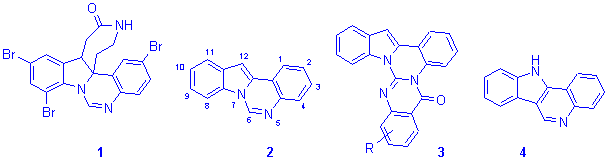
For the last two decades, marine natural products have constituted an important source of inspiration for chemists and have received increasing attention as a source of new and useful pharmaceuticals and biologically active compounds.1 Hinckdentine A (1)2 is an unusual marine alkaloid which has a unique molecular skeleton consisting of a seven membered lactam ring fused to a indolo[1,2-c]quinazoline (2). This latest ring system is little known and its synthesis has been achieved in only a limited number of ways, mostly involving the use of 2-(2-aminophenyl)indole as starting material.2,3
Figure
In a search of new polyheterocyclic systems with potential pharmacological value,4 we planned to prepare new polyheterocyclic compounds (3) from 2-(2-aminophenyl)indole and by fusing the indolo[1,2-c]quinazoline 2 and the quinazolin-4-one rings. This synthesis was performed via a modified Niementowski reaction5 inspired by a recent work on the preparation of base-modified nucleosides by condensation of anthranilic acid with a suitably protected sugar-derived 2-alkylthio-1,3-oxazoline.6
In the course of our work on the use of microwaves in organic synthesis,7 we confirm (last step) that exposition of the reaction mixtures to microwaves allows striking reduction in reaction times, good yields and cleaner reactions than for the purely thermal procedures.
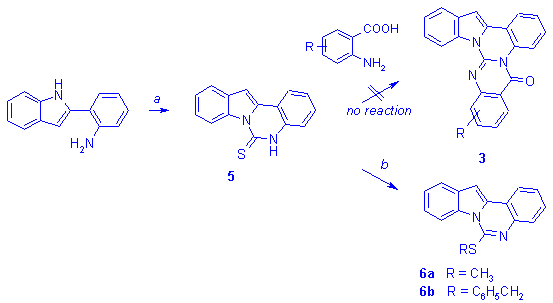
Preparation of 6-mercaptoindolo[1,2-c]quinazoline 5 was easily accomplished (85%) at 60°C by reaction of the starting 2-(2-aminophenyl)indole with carbon disulphide in the presence of potassium hydroxide. Whatever method was applied (various temperatures and times) none of the alternative ring closed product, indolo[3,2-c]quinoline (e.g. 4), was detected.8 The Niementowski reaction usually involves the condensation between anthranilic acids and various amides or thioamides (in dry media or with solvents).5 In a preliminary approach, our first intention was to fuse the indolo[1,2-c]quinazoline and the quinazolin-4-one rings by condensation of the cyclic thioamide 5 and anthranilic acid. Unfortunately, whatever conditions were used (classical thermal heating or microwave irradiation) no attempted product was detected. In accordance with a very recent paper cited above (see ref. 6), transformation of the mercapto group of compound 5 in a better leaving group was expected to favour the first nucleophilic attack of the amino group of anthranilic acid on carbon 6. Then, thermal cyclisation will occur with lost of water, to lead to a new polyheterocyclic skeleton.
Selective S-alkylation of the 6-mercaptoindolo[1,2-c]quinazoline 5 was performed with an excess of methyl iodide, in dimethylformamide, in the presence of sodium hydride (1 equiv.) as a base. It gave the intermediate 6-methylmercaptoindolo[1,2-c]quinazoline 6a in good yield (92%). Formation and use of the S-benzyl derivative 6b (as described in ref. 6) was also studied but condensation experiments performed have shown that the best results occured with the S-methyl compound as starting material.
Condensation of the indoloquinazoline derivative 6a with anthranilic acid in dry ethanol or n-butanol did not allow an access to the attempted ring. Transposition of such a process (same conditions of solvents and temperatures) in a microwave oven was also unsuccessful.
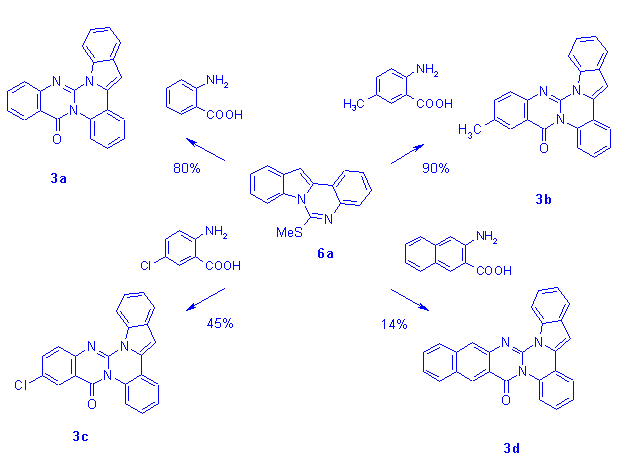
Scheme 2.
Reactions and conditions : anthranilic acid, graphite, microwaves (P 120W),
140°C, 30 min.
Graphite is one of the solids most efficiently heated by microwaves and is also known for its adsorbing properties of organic molecules. 9 In connection with our recent work on Pechmann reactions with carbon graphite/montmorillonite K10 as support,7a we discovered that microwave irradiation10 of a mixture of the indoloquinazoline 6 and an excess of anthranilic acid (6 equiv.), adsorbed on graphite, led to the cyclised compound 3a11in good yield and in a shorter time than for the purely thermal procedures (in similar experimental conditions, with same quantity of starting materials and graphite, a conventional heating gave a very poor yield of 3a after 24h).
This process was extended to various, anthranilic acids to give products 3b-d11 in various yields. Here again no by-products were detected and reactions were cleaner than for the purely thermal procedures (the yields observed are in accordance with the reactivity of such anthranilic acids in similar reactions:6 presence of an electron withdrawing aromatic system in the reagent was deleterious to the reaction).
Conclusion
In conclusion, we have described in this paper the preparation of novel triazabenzo[a]indeno [1,2-c]anthracen-5-ones (3a-c) and triazabenzo[a]indeno[1,2-c]naphtacen-5-one (3d) by fusion of the quinazolin-4-one ring and a S-methyl derivative of indolo[1,2-c]quinazoline. This synthesis, which was performed via a rarely described modified Niementowski reaction, is a further example of the utility of microwaves in organic synthesis. In connection with published results,12 this work confirms that failure of conventional thermal procedures can be substituted by microwave irradiation, allowing to develop easy and rapid access to original heterocycles with potential pharmaceutical value.
Acknowledgements
We thank the Comité de Charente-Maritime de la Ligue Nationale contre le Cancer for financial support.
References and notes
2. a) Billimmoria, A. D.; Cava, M. P. J. Org. Chem. 1994, 59, 6777-6782; b) Hinckdentine A (1) has been isolated from the bryozoan Hincksinoflustra denticulata, collected off the eastern coast of Tasmania: Blackman, A.; Hambley, T. W.; Picker, R.; Taylor, W. C.; Thirasana, N. Tetrahedron Lett. 1987, 28, 5561-5564.
3. Molina, P.; Alajarin, M.; Vidal, A. Tetrahedron 1990, 46, 1063-1078.
4. a) Bénéteau, V. Besson, T. Tetrahedron Lett.2001, 42, 2673-2676; b) Bénéteau, V.; Pierré, A.; Pfeiffer, B.; Renard, P.; Besson, T. Bioorg. Med. Chem. Lett.2000, 10, 2231-2234; c) Lamazzi, C.; Leonce, S.; Pfeiffer, B.; Renard, P.; Guillaumet, G.; Rees, C. W. Bioorg. Med. Chem. Lett.2000, 10, 2183-2185; d) Bénéteau, V.; Besson, T.; Guillard, J.; Léonce, S.; Pfeiffer, B. Eur. J. Med. Chem.1999, 34, 1053-1060.
8. Preparation of the indolo[3,2-c]quinoline 4 was performed in two steps following a procedure previously described by Molina (ref. 3) by intramolecular reaction of iminophosphoranes with isocyanates.The final structure assignments of isomers 2 and 4 was confirmed by 2D 1H – 13C NMR HMBC correlation.
9. a) Walkiewicz J. W.; Kazonich, G.; Mc Gill, S. L. Min. Metall. Process. 1988, 5, 39-42; b) Microwave-assisted organic reactions supported on graphite were previously described in: (i) Marquié, J.; Laporterie, A.; Dubac, J.; Roques, N. Synlett2001, 493-496; (ii) Garrigues, B.; Laporte, C.; Laurent, R.; Laporterie, A.; Dubac, J. Liebigs Ann. 1996, 739-741.
10. Focused microwave irradiations were carried out at atmospheric pressure with a Synthewave S402 Prolabo microwave reactor (300 W, monomode system) which has quartz reactors, visual control, irradiation monitored by PC computer, infrared measurement and continuous feedback temperature control (Commarmot, R.; Didenot, R.; Gardais, J. F. French Patent 84/03496, 1986; Chem. Abst. 1986, 105, 17442.) Equipment of the oven can be completed by an external stirring system, a condenser and dropping funnel allowing conditions close to those involved in classical methods; it is also possible to work under dry atmosphere or in vacuo if necessary.
11. All compounds were fully characterised by spectroscopy and elemental analysis.
Typical procedure for the synthesis of 3a : A mixture of compound 6a (0.2 g, 0.75 mmol), anthranilic acid (0.374 g, 4.3 mmol) adsorbed on graphite (1g) was placed in the microwave oven in a 70 ml quartz vial. The irradiation was programmed at 120 W (after a period of 2-3 min the temperature reached a plateau, 140°C, and remained constant for 30 min). After cooling, the graphite powder was filtered and washed with dichloromethane. The organic solution was washed with a saturated solution of sodium bicarbonate, and the crude product recrystallized in ethanol. Remarks : (a) in this process 6 equiv. of anthranilic acid are necessary, other experiments with 1, 2 and 4 equiv. of this acid were not satisfactory; (b) the ratio between the quantity of reactant and the graphite is very important; if it is too large or too small, degraded or incomplete reactions were observed.
12. For a complete review see: Loupy, A.; Petit, A.; Hamelin, J.; Texier-Boullet, F.; Jacquault, P.; Mathé, D. Synthesis 1998, 1213-1234.