
MICROWAVE-ASSISTED, SOLVENTLESS SUZUKI COUPLING REACTIONS ON PALLADIUM-DOPED ALUMINA
George W. Kabalka*, Richard M. Pagni, Lei Wang, Vasudevan Namboodiri,
*Departments of Chemistry and Radiology, The University of
Tennessee, Knoxville, TN 37996-1600
E-Mail: [email protected]
Received: 15 August 2001 / Uploaded 22 August 2001
INTRODUCTION
The formation of carbon-carbon bonds via the palladium catalyzed coupling of organoboranes with organic halides (the Suzuki reaction) has become an integral part of modern organic synthesis.1, 2 The popularity of the Suzuki reaction is a consequence of the ready availability of a wide variety of functionally substituted boron derivatives and the mildness of the coupling reaction itself. Suzuki reactions generally employ organic solvents such as tetrahydrofuran and ethers as well as complex palladium catalysts which are soluble in these solvents. These palladium reagents tend to be expensive and sometimes difficult to manipulate and recover. The solvents pose recyclability (and waste handling) problems of their own.
We recently reported a solventless modification of the Suzuki reaction which solved some of these problems,3 by using a commercially available Al2O3 potassium fluoride mixture to which we added palladium powder. In addition, since the palladium catalyst remained on the alumina surface, simple filtration afforded an efficient route to isolating the desired products and recovering the catalyst.4
Microwave irradiation of organic reactions has gained in popularity in recent years since it was found to accelerate a wide variety of transformations.5, 6 In recent years, a number of reports have appeared in which the organic reagents are coated onto surfaces which themselves absorb little or no microwave energy; in these instances, the reactive species absorb the microwave energy but the bulk temperature of the reaction mixtures tends to rise only modestly.
We report an energy efficient modification of our solid-state Suzuki chemistry which enhances the reactions eco-friendly attributes. The new methodology couples microwave irradiation with a solid-state, solvent free approach and leads to enhanced yields of the desired products, equation 1. We also evaluated the ability to recycle the catalyst.
Equation 1.
RESULTS AND DISCUSSION
In our earlier studies, it was determined that Suzuki reactions readily occurred in the presence of relatively inexpensive palladium powder and alumina. The presence of potassium fluoride was required to achieve high yields of the desired products which was fortuitous since mixtures of potassium fluoride and alumina were commercially available at reasonable cost. In the initial studies, the reactants were mixed (in the absence of a solvent) and the mixture heated for four or more hours at temperatures approaching 100 oC.
In the current study, we examined the effectiveness of microwave irradiation for enhancing the rate of these reactions. As a probe, we investigated the reaction of o-tolylboronic acid with iodobenzene for various periods of time. For convenience, we found it most efficient to simply heat the mixtures for 2 minutes.
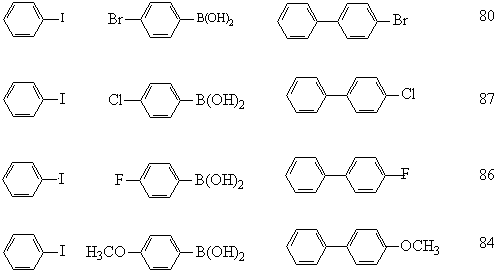
We then examined the reactions of a variety of aryl halides with arylboronic
acids containing both electron-donating and electron-attracting substituents,
Tables 1 and 2. As can be seen from the data contained in Table 1 and 2, the
reaction appears to be insensitive to the substituents on the boronic acid.
However, the reaction is most efficient when aryl iodides are used as the
co-reactant. In fact the reactivity trend aryl iodide > aryl bromide >
aryl chloride > aryl fluoride parallels the trend observed in Suzuki
reactions carried out in solution.
| Table 1. Microwave Enhanced Reaction of Aryl Halides (ArX) with Boronic Acids [RB(OH)2] |
| ArX RB(OH)2 Product Yield (%) |
 |
| Table 2. Microwave Enhanced Reaction of Aryl Halides (ArX) with Boronic Acids [RB(OH)2] |
| ArX RB(OH)2 Product Yield (%) |
 |
Reactions of vinyl boronic acids with aryl halides were also successful, equation 2. But no reactions occurred when alkylboronic acids were utilized or when alkyl halides were used.
Equation 2.

The surface recyclability was also evaluated and the results are listed in Table 3.
| Table 3. Successive Trials | |
 | |
|
|
|
|
2 3b 4b 5b 6 |
82 81 76 83 84 |
| aIsolated Yields. bExperiments were carried out as described in the Experimental Section except that the catalyst surface was isolated by adding methanol (5 mL) and hexane (5 mL). After decanting the solvent, the surface was washed with hexane (3 x 5 mL). Additional KF was added (0.40 g) and the coupling reaction repeated. | |
EXPERIMENTAL PROCEDURE
A commercially available 1000 watt microwave oven was utilized in the study. The oven was operated at 100% power. Requisite boronic acids were obtained commercially or were prepared via literature procedures.7 KF/Al2O3 was prepared by dissolving KF in a minimum amount of methanol and adding it to Grade 1 alumina. The ratio of KF to alumina was 40% (by weight). The methanol was removed under reduced pressure until the KF/Al2O3 mixture was powdery. The synthesis of 4-methylbiphenyl is representative: to a mixture of KF/Al2O3 (0.950 g, 40 % by weight) and palladium black (0.050 g, 0.470 mmole, 99.9+% as a submicron powder) was added p-methylphenylboronic acid (0.150 g, 1.10 mmole). Iodobenzene (0.209 g, 1.02 mmole) was then added and the mixture stirred at room temperature for 15-20 minutes to ensure efficient mixing. The flask was fitted with a septum (punctured by an 18 gauge needle), placed in a microwave and irradiated at 100% power for 2 minutes. [CAUTION: Heating volatile organic reagents in commercial microwaves for extended periods can lead to explosions.] After cooling, a small quantity of hexane was added and the slurry stirred at room temperature to ensure product removal from the surface. The mixture was filtered through a sintered glass funnel and the product isolated to yield 4-methylbiphenyl (82%); m.p. 44.0- 45.5 oC; 1H NMR (CDCl3; d): 7.40 (m, 9H), 2.37 (s, 3H).
CONCLUSIONS
The use of microwave irradiation in syntheses involving KF/alumina as a solid-phase support for solventless Suzuki reactions offers a convenient, environmentally friendly alternative to traditional reactions. Reaction times are reduced from hours to minutes, in addition the solid-phase syntheses provide one of the few successful Suzuki methodologies that can be carried out utilizing ligandless palladium reagents. The solid-state methodology offers the opportunity to recycle the reagent (via simple filtration) which has significant commercial appeal.
ACKNOWLEDGEMENTS
We wish to thank the U.S. Department of Energy and the Robert H. Cole Foundation for their support of this research.
REFERENCES