

Sixth International Electronic Conference on Synthetic Organic Chemistry (ECSOC-6), http://www.mdpi.org/ecsoc-6, 1-30 September 2002
[C002]
Flavonoids from the roots of Isoetes longissimum
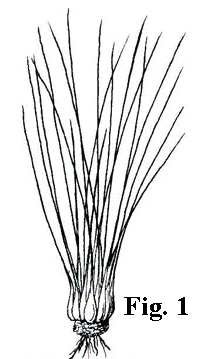
Isoetes longissimum Bory (see figure) is a rare aquatic pteridophyte whose only known European location is Galicia (northwest Spain), this specie has otherwise been recorded only from Algeria1. Due to this highly restricted distribution and known the particular sensitivity of oligotrophic fresh waters habitats, I. longissimum was classified by Salvo as endangered at European level in his listing of rare pteridophytes of the Iberian Peninsula.
In view of this, it was necessary to carry out a phytochemical study of this taxon, since it had never been studied before. This communication deals with the preliminary study of this specie, which afforded the isolation and characterization of 4 flavonoids.
The flavonoids isolated were identified by exhaustive analysis of 1H and 13C NMR spectroscopy, COSY, NOESY and HETCOR experiments, and by comparison of their spectroscopic properties with literature reports. These were: 5-hydroxy-7,4’-dimethoxyflavone2 (genkwanin, the major component), 7,3’,4’-trimethoxyluteolin,3 7,4’-dimethoxyluteolin,4 and 5-hydroxy-7,3’,4’,5’-tetramethoxyflavone3b,5 (corymbosin).
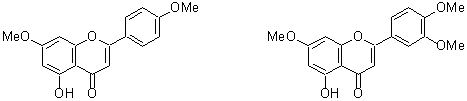
5-hydroxy-7,4’-dimethoxyflavone 7,3’,4’-trimethoxyluteolin, 7,4’-dimethoxyluteolin
1H RMN, 13C NMR, COSY, NOESY, HETCOR 1H RMN, 13C NMR, COSY, NOESY, HETCOR
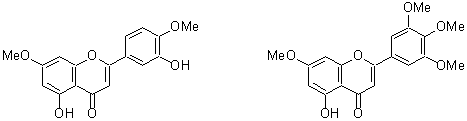
7,4’-dimethoxyluteolin 5-hydroxy-7,3’,4’,5’-tetramethoxyflavone
1H RMN, NOESY 1H RMN, 13C NMR, COSY, NOESY, HETCOR
Plant material
The roots were collected in Jly 201 at Parga river, Lugo (Spain). A voucher specimen documenting the collection is on deposit at Lugo Herbarium (nº 820).
Acknowledgments
Xunta de Galicia ( infraestructura PR405A 98/59-0 and project PGIDT01PXI26203PR) for financial support.
1.- Salvo, E.; "Guía de helechos de la península ibérica y baleares", Ed. Pirámide S. A, Madrid 1990.
2.- Zembower, D. E.; Zhang, H., J. Org. Chem. 1998, 63, 9300-9305.
3.- a)Ahond, A.; Guilhem, J.; Hamon, J. ; Hurtado, J.; Ponpat, C.; Pusset, M.; Séveret, T.; Poiter, P. J. Nat. Prod. 1990, 53, 875-881. b) Zahir, A.; Jossang, A. J. Nat. Prod. 1996, 59, 701-703.
4.- Ampofo, S. A.; Roussis, V.; Wiemer, D. F. 1987, 26, 2367-2370.
5.- Joshi, B. S.; Rane, D. F. Tetrahedron Lett. 1967, 46, 4579-4581.