Sixth International Electronic Conference on Synthetic Organic Chemistry (ECSOC-6), 1-30 September
[E009]
In the recent article
[1] we
presented comparative study of the Knoevenagel condensation under microwave
radiation and conventional heating. This paper is continuation of that work.
The most important factor, which
influence directly on reaction rate is, of course, the temperature and thermal
homogenity of reaction system [2]. In our
work we have used fiberoptic thermometer (Nortech), that is designed for
temperature measurement in strong electromagnetic fields (radio and microwave
frequencies). Additionally we checked this instrument by measure boiling points
of typical liquids (water, ethanol) under microwave radiation (to avoid
superheating of solvent boiling chips and stirrer was used). Arrrhenius
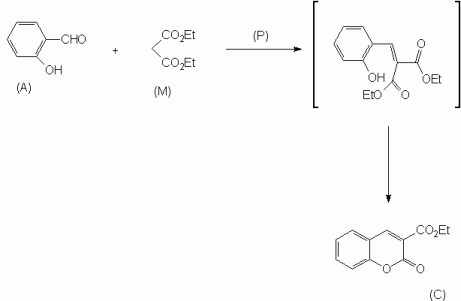
parameters for examinated reaction (Scheme 1) were determinated and
concentration of reagents depend on temperature profile in two cases: (1)
second-order and (2) pseudo first-order condition (Scheme 2, Scheme 3) were
calculated. Since the reacting mixture strongly absorbs microwave radiation, we
used water flow in glass cooler to keep appropriate temperature of reaction
mixture. [1].
Scheme 1. Synthesis of 3-ethoxycarbonylcumarine (C) over Knoevenagel condensation of salicylaldehyde (A) and diethylmalonate (M), piperydine (P) catalysed in toluene as solvent.
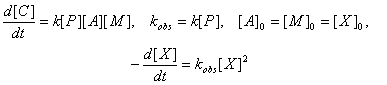
Scheme 2. Second-order reaction kinetics equation.
[X]0 = 0.18 mol/l, [P]=0.047 mol/l. Case (1).
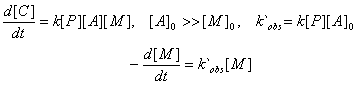
Scheme 3. Pseudo first-order reaction kinetics equation.
[A]0 = 1.22 mol/l, [M]0 = 0.11mol/l, [P] = 0.043 mol/l.
Case (2).
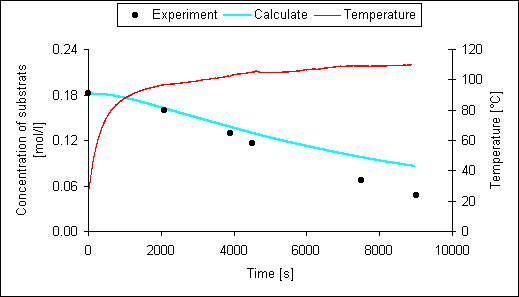
Figure 1. Typical example of reaction course – case (1) 27W.
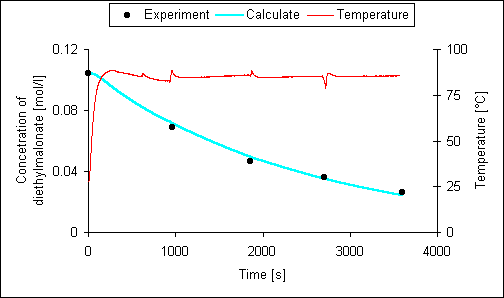
Figure 2. Typical example of reaction course – case (2)
150W.
Table 1. Deviation (SSE) between calculated and
measured concentration. Case (1) N=6 and (2) N=5 data points (Y)
| Case | Reaction condition | SSE |
| (1) | 27W | 2.55E-3 |
| (1) | 90W | 4.17E-3 |
| (1) | 150W | 1.88E-3 |
| (1) | conventional | 2.42E-4 |
| (2) | 150W | 2.91E-5 |
| (2) | conventional | 5.26E-5 |
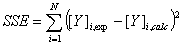
The significant influence (expressed as the sum of squares of the error SSE) of microwave irradiation on reaction rate (Table 1) were observed. In case (1), in each experiments measured concentration of substrats were lower than calculated. Observed microwave effect is significant, but small. It is thought that there is a non-thermal microwave effect [3], because reaction temperature were measured precisely and reaction medium was non-polar (toluene) to avoid solvent superheating [4]. In more polar medium – case (2) (excess of salicylaldehyde) the affirmation of microwave influence were not detected.
[1] ECSOC5
[2] Stuerga D., Gaillard P., Tetrahedron, 1996,
52, 5505
[3] Perreux L., Loupy A., Tetrahedron,
2001, 57, 9199
[4] Gabriel C., Gabriel
S., Grant E.H., Halstead S.J., Mingos D.M.P., Chem. Soc. Rev., 1998,
27,213