8th International Electronic Conference on Synthetic Organic Chemistry. ECSOC-8. 1-30 November 2004. http://www.lugo.usc.es/~qoseijas/ECSOC-8/
[A029]

ARE 4-VINYLTHIAZOLES PROMISING SYNTHETIC TOOLS
AS DIENES IN DIELS-ALDER CYCLOADDITIONS?
Mateo Alajarín, Aurelia Pastor, José Cabrera, Pilar Sánchez-Andrada
Departamento de Química Orgánica, Facultad de Química
Universidad de Murcia, Campus de Espinardo
E-30.100 Murcia, Spain
 Diels-Alder
Cycloadditions with 4-Vinylthiazoles?
Diels-Alder
Cycloadditions with 4-Vinylthiazoles?
Although the number of Diels-Alder (DA) cycloadditions with open-chain and alicyclic dienes is very large, the number of examples with aromatic heterocyclic compounds is relatively small.[1] The introduction of a vinyl group as a substituent onto a heterocycle increases the number of possibilities of reaction. This new possibility, although attractive for synthetic purposes,[2] is successful, with a few exceptions, only with p-excessive five-membered heterocyclic derivatives (mainly vinylpyrroles,[3] vinylpyrazoles[4] and vinylindoles[5]). As it is usual in this kind of reactions, Michael additions, ene reactions, [2+2] cycloadditions, and polymerization compete with the Diels-Alder cycloaddition. To the best of our knowledge, no reports describing the behaviour of 4-vinylthiazoles as dienes in this kind of reactions have been disclosed. The functionalization of the thiazole ring[6] is generally a difficult task since, owing to its electron-deficient aromatic character, this heterocycle is very resistant to both electrophilic substitutions and additions, as well as cycloadditions across the formal C=C and C=N double bonds.[7]
 Promising HOMO Energy Values! ....
The HOMO energies of several 4-vinylthiazoles with different substituents at 2 position of the thiazole ring were determined through single-point RHF calculation using the 6-31G basis at the B3LYP/6-31G geometries (GAUSSIAN 98). These HOMO energy values were compared with those of the well-known Danishefsky and Rawal dienes[8] and are all included in Table 1.
|
Table 1 |
|||
|
Entry |
Diene |
HOMO eigenvalue (eV) |
|
|
1 |
|
-8.08 |
|
|
2 |
|
-7.18 |
|
|
3 |
|
X=Ph |
-8.01 |
|
4 |
X=Me |
-8.41 |
|
|
5 |
X=H |
-8.65 |
|
|
6 |
|
X=Ph |
-7.47 |



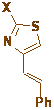
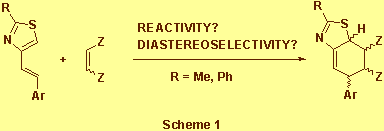
According to the data shown in Table 1, the HOMO values are very close to those calculated for the Danishefsky and Rawal dienes (entries 1 and 2). Interestingly, a lowered energy value when introducing a phenyl substituent at b-position of the vinyl group was observed (entry 6). Consequently, 4-vinylthiazoles with aromatic substituents at this position (shown below) where chosen to test their behaviour in Diels-Alder reactions as the 4p-component. This kind of processes would be of high interest since methodologies to annelate a six-membered ring to a heterocyclic system are mandatory in the synthesis of polycyclic heterocycles of biological activity (Scheme 1).
Results and discussion
Synthesis of the 4-Vinylthiazoles 1
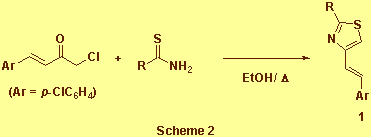
The 4-vinylthiazoles 1a-b were obtained by reaction of the corresponding a-chloroketone and thiobenzamide or thioacetamide in excellent yields as depicted in Scheme 2 and Table 2.
|
Table 2 |
|||
|
Entry |
R |
4-Vinylthiazole |
Yield (%) |
|
1 |
Ph |
1a |
90 |
|
2 |
CH3 |
1b |
90 |
FIRST ATTEMPT: PTAD, One of the Most Reactive
Dienophiles!
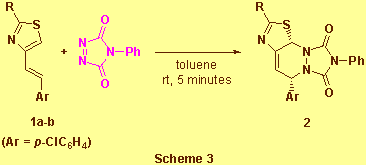
The vinylthiazoles 1a-b were allowed to react with PTAD in toluene at room temperature (Scheme 3, Table 3). The reaction was complete after just 5 minutes (at that moment the intense pink colour of the PTAD fade off). The corresponding Diels-Alder adducts 2a-b were isolated in quantitative yields as one single diastereomer.
|
Table 3 |
|||
|
Entry |
R |
Product |
Yield (%) |
|
1 |
Ph |
2a |
quant. |
|
2 |
CH3 |
2b |
quant. |
The relative configuration of the chiral carbon atoms in the cycloadducts 2 was determined on the basis of the observed cross-peaks in 2D NOESY experiments.
What about Maleimides?
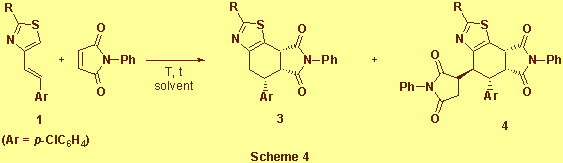
The vinylthiazole 1a was reacted with 1equiv. of N-phenylmaleimide (NPM) in toluene at 140 ºC leading to a mixture of two unexpected products: 3a and 4a (Scheme 4; Table 4; entry 1). Whereas 3a was the expected DA adduct after migration of the double bond to the next position, 4a was the result of the reaction of the vinylthiazole 1a with two molecules of NMP. The 3a/4a ratio was dramatically dependent on the solvent. Thus, whereas the formation of 4a was completely suppressed in acetonitrile (Table 4; entry 2), 4a was the mayor product when the reaction was carried out without solvent (Table 4; entry 3). The reaction of the 4-vinylthiazole 1b with NPM in acetonitrile at 120 ºC led to the corresponding adduct 3b in excellent yield (91%) together with an small amount of 4b (8%) (Table 4; entry 4).
|
Table 4 |
||||||||
|
Entry |
Vinylthiazole |
R |
1:NPM |
Solvent |
T (ºC) |
t (h) |
3 (%) |
4 (%) |
|
1 |
1a |
Ph |
1:1 |
toluene |
140 |
29 |
46 |
18 |
|
2 |
1a |
Ph |
1:3 |
acetonitrile |
120 |
48 |
95 |
0 |
|
3 |
1a |
Ph |
1:4 |
neat |
120 |
4 |
21 |
66 |
|
4 |
1b |
Me |
1:3 |
acetonitrile |
120 |
48 |
91 |
8 |
The relative configuration of the chiral centers in cycloadducts 3 and 4 was determined on the basis of their NMR spectroscopic data and, in particular, the value of the coupling constants of vicinal protons and the observed cross-peaks in 2D NOESY experiments.
Is There a Common Intermediate in the Formation
of 3 and 4?
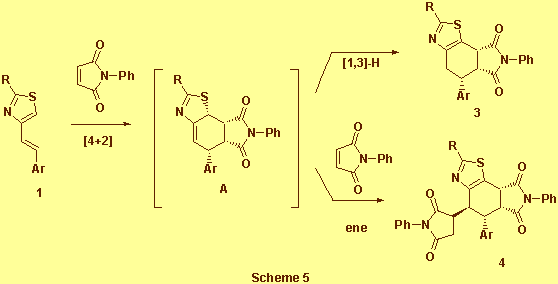
The formation of 3 and 4 may be easily explained in terms of an endoselective Diels-Alder cycloaddition between the vinylthiazoles 1 and NPM to give the intermediate A (Scheme 5). This intermediate would undergo a [1,3]-H shift leading to 3, or alternatively, experience an endoselective ene reaction with a second molecule of NPM to give 4. These last two reactions would be favoured as a consequence of the rearomatization of the thiazole ring. The intermediacy of A was confirmed when it was isolated under milder conditions.
Conclusions
 4-Vinylthiazoles behave as dienes in DA
cycloadditions in spite of the electron-deficient character of the heterocyclic
nucleus.
4-Vinylthiazoles behave as dienes in DA
cycloadditions in spite of the electron-deficient character of the heterocyclic
nucleus.
The reactions of 4-vinylthiazoles 1 with PTAD afford the corresponding
Diels-Alder adducts in quantitative yields.
The reactions of 4-vinylthiazoles 1 and NPM in acetonitrile lead
diastereoselectively to the corresponding endo-adducts
which undergo a [1,3]-H shift to give 3
in excellent yields.
When the reaction of 4-vinylthiazole
1a and NPM takes place in the
absence of solvent the adduct 4a
was isolated as the major product. The formation of 4 may be explained by a consecutive Diels-Alder and ene
reactions both taking place endoselectively. These two consecutive processes provide
absolute stereocontrol in the formation of the five chiral centers in 4.
References
[1] a) F. Fringuellli, A. Taticchi, Ed. The Diels-Alder Reaction: Selected Practical Methods; John Wiley&Sons, Ltd: Electronic, 2002. b) W. Oppolzer, Angew. Chem., Int. Ed. Engl. 1984, 23, 876.
[2] J. Sepúlveda-Arques, B. Abarca-González, M. Medio-Simón, Adv. Heterocycl. Chem. 1995, 63, 339.
[3] a) L. R. Domingo, R. A. Jones, M. T. Picher, J. Sepúlveda-Arques, Tetrahedron 1995, 51, 8739. b) D. Xiao, D. M. Ketcha, J. Heterocyclic Chem. 1995, 32, 499.
[4] a) K. Kosaka, K. Maruyama, H. Nakamura, M. Ikeda, J. Heterocyclic Chem. 1991, 28, 1491. b) M. A. Walters, M. D. Lee, Tetrahedron Lett. 1994, 35, 8307. c) C. J. Lovely, H. Du, H. V. R. Dias, Org. Lett. 2001, 3, 1319.
[5] a) F. Le Strat, J. Maddaluno, Org. Lett. 2002, 4, 2791. b) T. G. Back, A. Pandyra, J. E. Wulff, J. Org. Chem. 2003, 68, 3299.
[6] J. V. Metzger, Ed. Thiazole and Its Derivatives; Wiley: New York, 1979.
[7] D. N. Reinhoudt, Adv. Heterocycl. Chem. 1977, 21, 253.
[8] S. A. Kozmin, M. T. Green, V. H. Rawal, J. Org. Chem. 1999, 64, 8045.
Acknowledgements
This work was supported by MCYT-FEDER (Project BQU2001-0010) and the Fundación Séneca-CARM (Project PI-1/00749/FS/01). A. P. and J. C. thank to the Ministerio de Educación y Ciencia of Spain for a Ramón y Cajal contract and for a fellowship, respectively.