8th Electronic Conference on Synthetic Organic Chemistry
Institute of
Applied Synthetic Chemistry
Vienna
University of Technology
8th International Electronic Conference on Synthetic Organic Chemistry. ECSOC-8. 1-30 November 2004. http://www.lugo.usc.es/~qoseijas/ECSOC-8/
[E007]
|
|
8th Electronic Conference on Synthetic Organic Chemistry
Institute of
Applied Synthetic Chemistry |
Microwave Assisted and Conventional Mono Aryl Substitution of Diazabicycloalkanes by Palladium Coupling
Jaroslav Skubak, Behrooz H. Yousefi, Kishor More, Shahzad A. Siddiqi, Doris Domin, Jaywant Phopase and Ulrich Jordis*
Institute of Applied Synthetic
Chemistry, Vienna University of Technology,
Getreidemarkt 9, 1060 Vienna, Austria,
[email protected]
Abstract
The typical synthetic routes to the mono-aryl substituted piperazines are palladium catalyzed C-N coupling of piperazine or protected piperazines with aryl halides. In this work we describe the synthesis of aryl piperazines and aryl diazabicycles utilizing Pd catalyzed coupling reactions using protected and unprotected piperazines and diazobicycles performed both conventionally and by microwave assisted organic synthesis (MAOS).
Introduction
Aryl piperazines are recurring substructures in many pharmaceuticals, such as ligands of serotonin (5-HT)
receptors, and key moieties of a variety of biologically active compounds, such as antifungals, antivirals,
antibacterials or cholesterol ester transfer protein inhibitors.1-5 The typical synthetic routes to the mono-aryl
substituted piperazines are palladium catalyzed C-N coupling using an excess of piperazine or protected
piperazines.
Since the first reports on microwave synthesis,6,7 MAOS has created completely new possibilities in performing chemical transformations.8 Microwaves heat reactants much more quickly compared to conventional means and many syntheses that usually take hours can be done in just a few minutes. Microwave quick heating is significantly beneficial in accelerating almost all conventional heated chemistries. The salient reported features of the MAOS approach are the enhanced selectivity, improved reaction rates, milder and solvent free reaction conditions, and formation of cleaner products with associated ease of manipulation.8,9
Results and Discussion
A literature survey revealed reports using excess piperazine in Buchwald Pd catalyzed aryl aminations.10-12 The use of excess of 2 is unfavourable with valuable bases. However some reports use a small excess of piperazines in such reactions.13-15 We compared the yields of 4 obtained either by the coupling of mono-protected 2 followed by deprotection or by direct arylation of unprotected 2. The results of a protocol using 1.2 eq. aryl halides, palladium dibenzylidene acetone (1 mol%) and BINAP (3 mol%) in toluene at 90°C followed by Boc-deprotection with TFA/CH2Cl2 according to Scheme 1 are summarised in Table 1.

Scheme 1
Table-1 Arylation of N-Boc-2,5-diazabicyclo[2.2.1]heptane: influence of base and reaction time
|
Ar |
Time (h) |
Base |
3 Yield (%) |
4 Yield (%) |
Overall yield (%) |
|
2-methoxyphenyl- |
48 |
Cs2CO2 |
21 |
71 |
14 |
|
2-methoxyphenyl- |
5 |
t-BuONa |
67 |
71 |
48 |
|
2-methoxyphenyl- |
8 |
t-BuONa |
80 |
80 |
64 |
|
3-methoxyphenyl- |
48 |
Cs2CO2 |
21 |
65 |
14 |
|
3-methoxyphenyl- |
5 |
t-BuONa |
65 |
65 |
42 |
|
3,5-dimethoxyphenyl- |
12 |
t-BuONa |
72 |
64 |
46 |
|
4-methoxyphenyl- |
48 |
Cs2CO2 |
19 |
55 |
10 |
|
4-methoxyphenyl- |
5 |
t-BuONa |
68 |
55 |
37 |
|
4-methoxyphenyl- |
12 |
t-BuONa |
78 |
87 |
69 |
|
4-formylphenyl- |
12 |
t-BuONa |
3 |
53 |
2 |
|
4-formylphenyll- |
16 |
Cs2CO2 |
74 |
53 |
38 |
|
4-acetylphenyl- |
12 |
t-BuONa |
24 |
63 |
14 |
|
4-acetylphenyl- |
16 |
Cs2CO2 |
42 |
63 |
26 |
For a set of parallel reactions the coupling of 2 was performed at 100°C for 16h and the results are summarised in Table 2.
Table-2 Parallel arylation of N-Boc-2,5-diazabicyclo[2.2.1]heptane
|
Aryl |
Pd2dba3 |
BINAP |
Scale |
yield |
|
|
|
mol% |
Mol% |
mmol |
% |
|
|
2-methoxyphenyl |
1 |
3 |
10 |
53 |
|
|
3-methoxyphenyl |
0.5 |
1.5 |
10 |
63 |
|
|
4-methoxyphenyl |
0.5 |
1.5 |
10 |
65 |
|
|
3,5-dimethoxyphenyl * |
2 |
6 |
25 |
54 |
|
|
1-naphthalyl |
1 |
3 |
37 |
63 |
|
|
4-biphenyl |
0.5 |
1.5 |
33 |
53 |
|
|
3,4-(methylendioxy)phenyl |
0.5 |
1.5 |
38 |
58 |
|
|
4-(brommethyl) phenyl |
0.5 |
1.5 |
31 |
47 |
|
|
2-trifluoromethylphenyl |
0.5 |
1.5 |
29 |
19 |
|
|
3,5-dimethylphenyl |
0.5 |
1.5 |
20 |
6 |
|
|
4-fluorophenyl |
0.5 |
1.5 |
21 |
52 |
|
|
4-thiomethoxyphenyl |
0.5 |
1.5 |
18 |
48 |
|
|
3-acetophenyl |
0.5 |
1.5 |
18 |
30 |
|
|
4-(methylethoxy)phenyl |
0.5 |
1.5 |
17 |
11 |
|
|
* Reaction condition 8h and 90°C |
|
|
|||
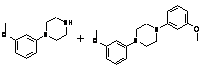
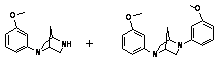
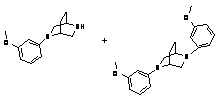
For the comparison of conventional and microwave assisted synthesis the reaction according to Scheme 2 was performed.
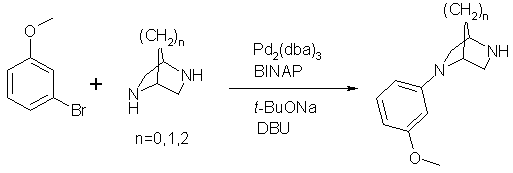
Scheme 2
Table-3 Conventional and Microwave synthesis results. (1equiv. of (bridged) piperazine, Pd2(dba)3 1 mol%, BINAP 3 mol%
and 1.5 eq. t-BuONa in closed CEM vial.15
|
Amine |
Time (min) |
Temp. (ºC) |
Solvent |
HPLC Conversion of m-bromoanisol (%) |
HPLC Ratio mono/diarylated product |
Scale (mmol) |
µW |
Product |
|
|
10 |
120 |
78 |
80:20 |
2 |
+ |
|
|
|
15 |
160 |
Toluene |
98 |
51:49 |
2 |
+ |
||
|
180 |
75 |
Toluene |
67 |
81:19 |
2 |
- |
||
|
240 |
75 |
Toluene |
84 |
76:24 |
2 |
- |
||
|
|
||||||||
|
|
15 |
140 |
Toluene |
62 |
30:70 |
1 |
+ |
|
|
15 |
150 |
Toluene |
73 |
66:34 |
1 |
+ |
||
|
300 |
65 |
Toluene |
67 |
66:34 |
1 |
- |
||
|
35 |
140 |
Toluene |
64 |
32:68 |
1 |
+ |
||
|
35 |
150 |
Toluene |
85 |
38:62 |
1 |
+ |
||
|
15 |
160 |
Toluene |
99 |
64:36 |
1 |
+ |
||
|
15 |
160 |
DMF |
99 |
93:7 |
1 |
+ |
||
|
|
|
|
||||||
|
15 |
160 |
DMF |
99 |
74:26 |
0.5 |
+ |
||
|
|
||||||||
Based on the results obtained with the anisidine fragment optimum conditions for mono-arylation of unprotected 2,5-dizabicyclo[2.2.1]octane was microwave irradiation at 160ºC for 15 min in DMF.
Conclusion
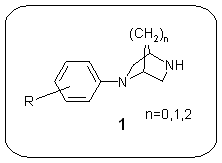
We have demonstrated the synthesis of substituted aryl diazabicycles of the type depicted in structure 1 utilizing Pd catalyzed coupling reactions using protected and unprotected conformationally fixed diazabicycles including the use of microwave reactions. Additionally, no excess of the (bridged) piperazine was used thus optimizing this type of reactions for valuable dibasic amines. The study of new catalysts and different ligands system at various conditions for mono- and diaryl diazacycloalkanes still is continuing in our group.
References
1. Brenner E, Schneider R, Fort Y, Tetrahedron 2002, 58, 6913.
2. Hepperle, M.; Eckert, J.; Gala, D. Tetrahedron Lett. 1999, 40, 5655.
3. Eckert, J.; Chan, T.-M.; Osterman, R. M.; Lambert, J. B.; Gala, D. Tetrahedron Lett. 1999, 40, 5661.
4. Heeres, J.; Backx, L. J. J.; VanCutsem, J. J. Med. Chem. 1984, 27, 894.
5. Saksena, A. K.; Girijvallabhan, V. M.; Wang, H.; Liu, Y. T.; Pike, R. E.; Ganguly, A. K. Tetrahedron Lett. 1996, 37, 5657.
6. Gedye, R.; Smith, F.; Westaway, K.; Ali, H.; Baldisera, L.; Laberge, L.; Rousell, J. Tetrahedron Lett. 1986, 27, 279-282.
7. Giguere, R. J.; Bray, T. L.; Duncan, S. M.; Majetich, G. Tetrahedron Lett. 1986, 27, 4945-4958.
8. (a) Hayes, B. L. Microwave Synthesis: Chemistry at the Speed of Light; CEM Publishing: Matthews, NC, 2002. (b) Microwaves in Organic Synthesis; Loupy, A., Ed.; Wiley-VCH: Weinheim, 2002. (c) Microwave-Assisted Organic Synthesis; Lidström, P., Tierney, J. P., Eds.; Blackwell Publishing: Oxford, 2004.
9. For online resources and a literature database on microwave-assisted organic synthesis, see: http://www.maos.net.
10. Campiani, G.; Butini, S.; Trotta, F.; Fattorusso, F.; Catalanotti, B.; Gemma A.; Nacci, A.; Novellino, E.; Stark, J. A.; Cagnotto, A.; Fumagalli, E.; Carnovali, F.; Cervo, B.; Pennini, T. J. Med. Chem. 2003, 46, 3822-39
11. López-Rodríguez, M. L.; Benhamú, B.; Ayala, D.; Rominguera, J. L.; Murcia, M.; Ramos, J. A.; Viso A. Tetrahedron, 2000, 20 3245-53.
12. Torisawa, Y.; Nishi, T.; Minamikawa J. Bioorg. Med. Chem. 2002, 10, 4023-4027
13. Huang, Y.; Kegeles, L. S.; Bae, S.; Hwang, D.; Roth, B. L.; Savage, J. E.; Laruelle, M.; Bioorg. Med. Chem. Lett. 2001, 11, 1375-77.
14. Daniels, D. L.; Richert, C. Tetrahedrn Lett. 1996, 40, 4463-4465.
15. All microwave assisted synthesis was performed using CEM-Explorer which is an automated reaction handling module for maximum throughput and flexibility in a microwave-enhanced synthesis workstation. For more information see: http://www.cemsynthesis.com/html/exp_page.htm